How Kundalini Yoga Move Energy In The Body?
Kundalini yoga pictures our vital energy as coiled around the base of the spine like a serpent. It is focused around the root and navel chakras, the ‘baser’ instincts for humans for food, water, shelter and sex. By moving the energy upwards to the other chakras, we can achieve our higher selves through accessing our mental power and wisdom within.
The 7 chakras are supposed to be connected through a white central channel that runs from the anus, the root chakra, to the top of the head, the crown chakra. The central channel is supposed to be just in front of the spine. The goal is to move the energy up or down the central channel through movement, meditation, mantra and mudra.
Keep in mind when we discuss the chakras and central channel, we are not talking about the physical body but our energy body, sometimes referred to as the subtle body, compared to the gross body. In other words, if a doctor cut us open, they would not see chakras spinning, but the stomach, liver and so on of the gross body.
The energy movement is also triggered by different breathing patterns and another particular feature only found in Kundalini yoga, locks or bandhas.
In order to tune in and start moving the energy in the body, most Kundalini yoga classes will start with you standing or sitting. Let’s look at the main ways to sit in Kundalini yoga to start moving your energy.
How to sit for Kundalini Yoga
There are 8 main ways to sit in Kundalini yoga.
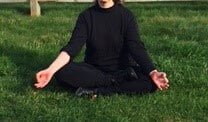
Easy pose
a comfortable cross-legged position. Often seen with Gyan mudra, making an O of the thumb and index finger by tucking the first joint of the index finger under the thumb and pressing lightly. This helps improve concentration.
Easy pose and other seated poses may also be done with Prayer pose, hands touching in front of the center of the chest, thumbs pressing lightly against the breast bone/sternum in order to stimulate the heart chakra.
Semi-divine pose
one leg with the foot resting on the opposite thigh. Also known as half-lotus
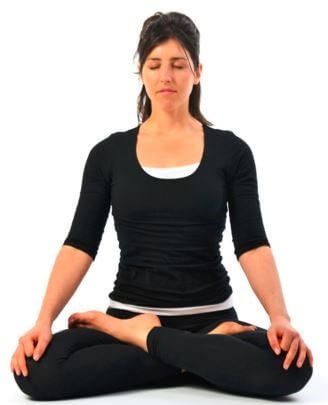
Full Lotus pose
The typical position associated with yoga. Both feet are resting on the opposite thighs. If you can’t manage this, either of the other 2 poses are fine. This is a great hip opening posture.
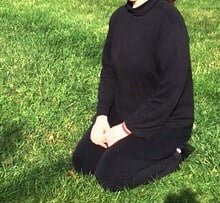
Rock pose
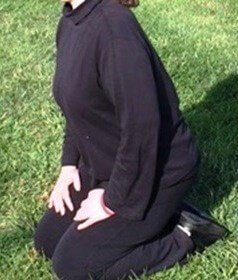
Sitting on your knees with your legs under you, your rear resting on your heels.
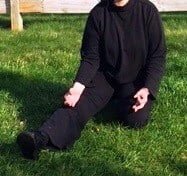
Heel to Root Chakra
Sitting on one knee with the heel of the foot pressing on the root chakra, around the region of your anus. Rest your hands on the tops of the thighs and sink into the pose.
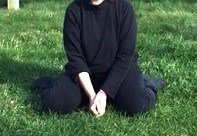
Celibate pose
Sitting with your buttocks on the floor but your legs parallel to one another, knees bent, calves parallel to the thighs and your ankles roughly parallel with your hips. This is another good hip-opening posture.
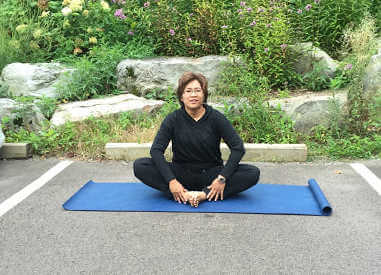
Butterfly pose
Sitting on the floor, knees bent, with the soles of your feet touching, legs spread wide at the hips. To increase the stretch, bounce the legs up and down gently. Never push down the knees. This is also a great posture for opening up the hips to get the energy flowing.
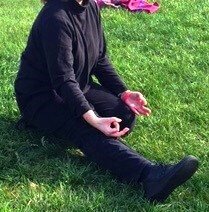
One leg stretched, sole of foot to inner thigh – This is like a sitting tree pose, with one leg stretched out in order to loosen the muscles and the other on the floor as if in easy pose but with the foot up as far as possible along the inner thigh. You will usually lean over the outstretched leg, either placing it straight in front of you, or moving it out to the side for a side stretch.
How to Breathe for Kundalini Yoga
As we mentioned above, pranayama, breath work, moves the energy in the body in all yoga. Kundalini yoga has a few interesting forms of breathing, with the most notable being breath of fire. Most of these breath patterns will be done sitting up, so find a comfortable seated position such as Easy pose or Lotus and then you can concentrate on the breath work.
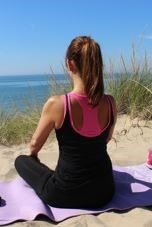
Breath of Fire
Breath of Fire is almost exclusively used in Kundalini yoga. It works a bit like hyperventilating through your nose, that is, breathing in and out rapidly. The movement is supposed to pump the navel chakra to awaken the Kundalini energy and move it upwards. If we think about an old-fashioned bellows that was used to light fires from a spark and keep them going while people cooked or forged iron in a blacksmith’s shop, for example, we will get the idea of how breath of fire should work.
Breath of Fire can be a bit tricky to master, but if you picture yourself as a happy puppy breathing in and out through the nose only, you should be able to develop a natural rhythm. Some yogis claim that 1 minute of breath of fire is the equivalent of miles of jogging or hundreds of sit ups.
Alternate Nostril Breathing
Alternate nostril breathing is used to keep the energies balanced in the body and to restore balance. We may not notice it, but our breathing can become uneven through both nostrils through things like colds, allergies and so on. This pranayama can help.
Sit comfortably with your spine erect and shoulders and face relaxed.
Place your left hand on the left knee, palm open.
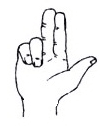
Using the pinkie and ring fingers of your right hand, position your hand according to the diagram above. Press those 2 fingers to your left nostril to close it.
Place the tips of your index and middle fingers on the third eye chakra, that is, the forehead just above the bridge of your nose.
Place the thumb on the right nostril lightly.
Breathe through the right nostril, taking long deep breaths, for at least 8 breaths. When you feel that the air is flowing freely, switch nostrils.
Now open the left nostril by moving the pinkie and ring fingers. Close off the right nostril this time using your thumb. Keep the index and middle fingers on your third eye chakra. Breathe in and out for eight, and then go on to the next activity, or repeat the cycle in each nostril 8 times each, for a total of 9 times. (72 in total)
As part of a Kundalini yoga set, your teacher will tell you exactly how long to do this breathing pattern by counting or by using a timer.