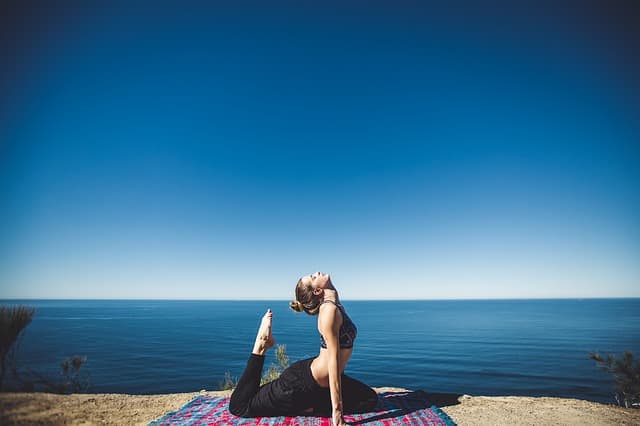
Kundalini yoga blends movement, dynamic breathing, chanting and meditation into short sets called kriyas. It was brought to the West by Yogi Bhajan in 1969 and is known as the “yoga of awareness”. Classes feel quite different from a typical stretch-and-hold yoga class: you might pump your spine in Cat-Cow for three minutes, breathe rapidly through your nose, then sit in silent meditation. This guide covers the ideas behind it (chakras and energy), how to sit and breathe, the mantras and mudras, and two simple kriyas you can try at home.
Key takeaways
- Kundalini yoga combines repeated movements, breath work, chanting and meditation.
- Its philosophy describes energy rising from the base of the spine through seven chakras.
- Key techniques: Breath of Fire, alternate nostril breathing, the body locks (bandhas) and mantras.
- It’s adaptable for all ages; go at your own pace and skip rapid breathing if you are pregnant or have heart or blood pressure problems.
- The chakra and energy concepts are spiritual traditions rather than scientific findings, but the breathing and meditation can help with stress.
There are many forms of yoga available, from traditional Hatha to the more modern inventions of Bikram and hybrid yoga style like Dahn, a combination of yoga and the martial art of tai chi. Kundalini (pronounced CUNH-dah-LEE-KNEE) yoga is the only form of yoga that is specifically designed to awaken quickly the power within everyone who practices it, for a healthier mind, body and spirit.
The awakened energy is then harnessed and directed in order to achieve particular goals. There’s no need to feel ‘stuck’ any more once you start to learn particular Kundalini yoga sets for the areas you wish to work on in your life.
We will outline the essentials of Kundalini yoga, its history, methods, and why it is so powerful. We will also outline several sets of Kundalini yoga exercises, known as kriyas (KREE-yah), to awaken the power within and boost health and vitality. So let’s get started with what Kundalini yoga is and why people practice it.
What is Kundalini Yoga and why do you need it?
The word Kundalini means coiled up and refers to the idea that valuable energy is coiled around the spine like a snake. The goal of Kundalini yoga, therefore, it to release this energy and move it up through the body so the energy can be directed in order for a person to transform their body, mind and spirit.
It is important to note that it is not just physical energy, but also spiritual energy, and what we might describe as inner wisdom. Kundalini yoga is seen to be one way of tapping into our spiritual force for greater awareness, raised consciousness, and closer connection with the cosmos so that we can achieve our full potential, a second meaning of the word Kundalini.

Most yoga practitioners will agree that Kundalini yoga will make any student very strong in a short amount of time, and without anyone having to turn themselves into a human pretzel. It is a great workout even if you are not interested in concentration and meditation.
It was founded in the 5th century AD and practiced for centuries in India. It was brought to the West by in the late 1960s by the teacher Yogi Bhajan, whose father had been a medical doctor. Yogi Bhajan began to study yoga at a very young age, perhaps with the thought that rather than try to cure disease, it was best to try to prevent it in the first place by maintaining a healthy body and mind. This is one of the main beliefs behind traditional Indian medicine, Ayurvedic medicine.
Yoga has been around for more than 5,000 years, so it does not belong to any one single religion or school of thought because it pre-dates religions. Having said that, if you see pictures of Yogi Bhajan, you will note that he had a turban and beard and wore white clothing. Yogi Bhajan followed the Sikh religious tradition. Sikh means student, and their teachers were known as Gurus, which actually means teacher rather than ‘expert’ as many people believe because the word is now so common in the West. Some people at the Kundalini yoga classes will wear turbans or wear white clothes, but most students are regular people of all ages, physical abilities and religious persuasions.
Yogi Bhajan died in 2004, but he left a legacy of health and healing through noting down the kriyas that had been passed down for generations and making the most of audio and video to record and preserve the kriyas and other teachings.
But is Kundalini yoga safe for everyone, including older people? Let’s discuss some of the reasons why it is in the next chapter.
Kundalini Yoga for Older Adults
Whenever you choosing the right exercise for you, safety should be paramount in your mind. This is particularly important if you have not worked out for a while. One of the beauties of yoga is that it use your own body weight to give you a good workout. Yoga can be done anywhere, and Kundalini yoga can be done anywhere at any time to awaken the power within and transform what you wish in your life once you have mastered a few basic poses and sets (kriyas).

There is no need to look like a bendy pretzel to get real results in Kundalini yoga. There is also no real emphasis on being as thin as a twig, or in working out to attain the ‘body beautiful’ as there is with other forms of yoga like Hatha. There are no levels as there are with Hatha and Bikram, no emphasis on competition as there is with Bikram, and no emphasis on perfection as there is with Bikram and Iyengar.
The main point is to awaken the Kundalini energy within to enhance your health and well-being of body, mind and spirit in each of your yoga sessions. Most of the poses are ones anyone can do if they concentrate and try their best. There should be no thought of ‘pushing through’ pain or trying to perfect a particular pose.
Some of the poses are standard as you would find in Hatha, others are interesting, might seem a bit odd, or are just plain fun.
Some kriyas will be mostly physical, and others predominantly meditational. Most will be a reasonable balance of both.
Most Kundalini yoga sessions lasts 90 minutes in most Kundalini yoga studios and will start with a warm up and cool down. It will also usually have a ‘tune in’ to quiet the mind and body to get ready for the work ahead. Most sets also contain a deep relaxation session, usually at the end of the class.
The tune in is a chant in Sanskrit repeated 3 times: ONG NA MO GURU DEV NAMO. It means, “I bow to the teacher within and to divine wisdom.” It is thought to be a way of awakening the energy channels in the body. At the end, you will tune out with “SAT NAM,” I am truth.
As with all exercises, warming up the muscles at the start of your session and cooling them down at the end of your workout are important to avoid injury. So too is hydration–bring your own water bottle or buy a bottle when you get to the studio. Most studios will offer Yogi tea at the end of each class for students to drink as they socialize with one another and relax. It is a decaffeinated tea similar to the Indian drink chai, and is made with Yogi Tea chai-style bags, soy milk and a splash of pure maple syrup to sweeten it.
Kundalini yoga teachers are supportive but not bullying. They will work with you to find adjustments for the pose if you have knee or back issues. There are also a number of props in each studio, such as cushion, blocks, and yoga straps to help you find whatever is comfortable for you.
They also have towels and mats so you do not have to carry yours around if you want to get in a session before or after work. Some studios also have showers if you want to freshen up afterwards.
You will find people of all ages at a Kundalini yoga, from young to senior. If you have not worked out for a while, you might feel very nervous about starting, and be especially scared at the very idea of putting on (fashionable) workout clothes and going to a gym full of fit 20-somethings.
With Kundalini yoga, all you need are comfortable clothes such as a tee shirt and shorts or yoga pants. A head covering like a scarf or bandana can keep the hair out of your eyes and is said to lock in the energy so it does not dissipate through the top of your head, your crown chakra, too quickly.
So what are the chakras, and how can they help with health and healing? Let’s look at this topic in the next chapter.
What are the Chakras?
The word chakra means wheel, or vortex. It is considered to be an energy center in the body that spins. Most illustrations of the chakras to explain them make them look like a round ball at each location, but this is not accurate. Rather than sitting on the front of our body, they actually spin from front to back like a dinner plate twirling. If we think of a whirlpool, we will also get an idea of the way chakras are positioned and function in our bodies.

Each chakras is the seat of a particular form of energy. There are 3 lower chakras and 4 higher chakras. If we use the comparison of the whirlpool again, our energy can remain at or sink down to the lower chakras unless we make a conscious effort to move our energy up to the higher chakras. In this way we can live a balanced and complete life.
Once you know where each of your chakras is, you can work on the health of each. Once they are each in balance, you can practice moving the energy upwards, endowing everything you with a whole new power and purpose.
As you awaken the power within, you will find yourself feeling a renewed sense of vitality. Work will become easier, your stress will decrease, and relationships improve. In terms of creating a great life for yourself, balanced chakras and an integrated mind, body, and spirit can be achieved through Kundalini yoga.
Each chakra corresponds to a color of the rainbow or spectrum. The healing energy pictured as coming in and out of the crown chakra is often shown as white light, that is, the combination of all of the colors of the spectrum.
Starting from the bottom and working our way to the top, the chakras are:
- The Root Chakra
- The Navel, Sex or Sacral Chakra
- The Solar Plexus Chakra
- The Heart Chakra
- The Throat Chakra
- The Third Eye Chakra
- The Crown Chakra
Colors and the Energies of each Chakra
1. The Root Chakra – Red
Stability, having life’s essentials, such as food, water and shelter. A balanced one means prosperity and ease. Imbalance triggers hardship, greed, and possibly eating disorders.
2. The Navel, Sex or Sacral Chakra – Orange
Passion, creativity, procreation. Balance give confidence and sex appeal. Imbalance creates timidity and the feeling of being stuck in a rut.
3. The Solar Plexus Chakra – Yellow
Willpower and personal power. Balance gives the energy and motivation to achieve all your goals. Imbalance means a lack of ambition or momentum. Think of the word solar, like the power of the sun, and you will get an idea of the importance of this chakra.
It is the highest of the 3 lower chakras. Moving the energy from here into the 4 upper chakras via the heart chakra is essential for awakening the power within.
4. The Heart Chakra – Green
Love, compassion, empathy. A balanced heart chakra gives you harmony in all your relationships. An imbalanced one closes you off to feelings and sensations, and makes you jealous of others.
5. The Throat Chakra – Blue
This is the seat of communication in all its forms. A balanced one helps you with all your spoken and written communications and allows you to tap into your authentic self. An imbalanced one results in lying, gossiping and being a bad listener.
6. The Third Eye Chakra – Indigo
Intuition, wisdom, especially spiritual wisdom. A balanced one helps you tap into your higher self and make connections with the spiritual. An imbalanced one makes you feel stuck or cut off from yourself. You have a hard time trusting your own judgment.
7. The Crown Chakra – Violet
The higher self. A balanced one leaves you open in mind, body and spirit. A closed one cuts you off from your highest potential and make you close-minded and closed off to connection with others.
Now that you understand the chakras, let’s look next at how the Kundalini yoga moves energy in the body.
How Kundalini Yoga Moves Energy in the Body
Kundalini yoga pictures our vital energy as coiled around the base of the spine like a serpent. It is focused around the root and navel chakras, the ‘baser’ instincts for humans for food, water, shelter and sex. By moving the energy upwards to the other chakras, we can achieve our higher selves through accessing our mental power and wisdom within.
The 7 chakras are supposed to be connected through a white central channel that runs from the anus, the root chakra, to the top of the head, the crown chakra. The central channel is supposed to be just in front of the spine. The goal is to move the energy up or down the central channel through movement, meditation, mantra and mudra.
Keep in mind when we discuss the chakras and central channel, we are not talking about the physical body but our energy body, sometimes referred to as the subtle body, compared to the gross body. In other words, if a doctor cut us open, they would not see chakras spinning, but the stomach, liver and so on of the gross body.
The energy movement is also triggered by different breathing patterns and another particular feature only found in Kundalini yoga, locks or bandhas.
In order to tune in and start moving the energy in the body, most Kundalini yoga classes will start with you standing or sitting. Let’s look at the main ways to sit in Kundalini yoga to start moving your energy.
How to sit for Kundalini Yoga
There are 8 main ways to sit in Kundalini yoga.
Easy pose
a comfortable cross-legged position. Often seen with Gyan mudra, making an O of the thumb and index finger by tucking the first joint of the index finger under the thumb and pressing lightly. This helps improve concentration.
Easy pose and other seated poses may also be done with Prayer pose, hands touching in front of the center of the chest, thumbs pressing lightly against the breast bone/sternum in order to stimulate the heart chakra.
Semi-divine pose
one leg with the foot resting on the opposite thigh. Also known as half-lotus
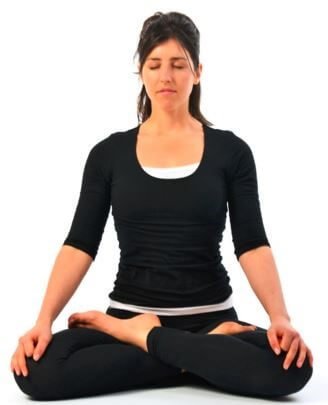
Full Lotus pose
The typical position associated with yoga. Both feet are resting on the opposite thighs. If you can’t manage this, either of the other 2 poses are fine. This is a great hip opening posture.
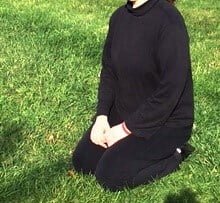
Rock pose
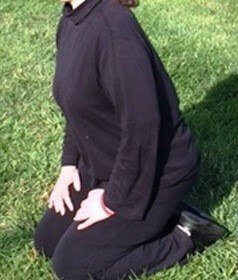
Sitting on your knees with your legs under you, your rear resting on your heels.
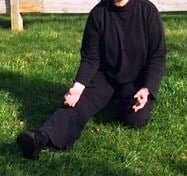
Heel to Root Chakra
Sitting on one knee with the heel of the foot pressing on the root chakra, around the region of your anus. Rest your hands on the tops of the thighs and sink into the pose.
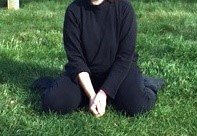
Celibate pose
Sitting with your buttocks on the floor but your legs parallel to one another, knees bent, calves parallel to the thighs and your ankles roughly parallel with your hips. This is another good hip-opening posture.
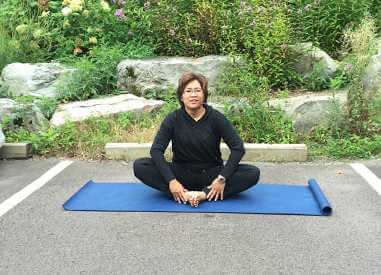
Butterfly pose
Sitting on the floor, knees bent, with the soles of your feet touching, legs spread wide at the hips. To increase the stretch, bounce the legs up and down gently. Never push down the knees. This is also a great posture for opening up the hips to get the energy flowing.
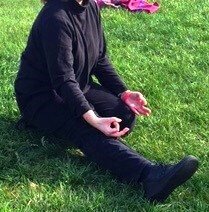
One leg stretched, sole of foot to inner thigh – This is like a sitting tree pose, with one leg stretched out in order to loosen the muscles and the other on the floor as if in easy pose but with the foot up as far as possible along the inner thigh. You will usually lean over the outstretched leg, either placing it straight in front of you, or moving it out to the side for a side stretch.
How to Breathe for Kundalini Yoga
Free tool
Breathing Exercise — practise slow, paced breathing with a visual guide.
As we mentioned above, pranayama, breath work, moves the energy in the body in all yoga. Kundalini yoga has a few interesting forms of breathing, with the most notable being breath of fire. Most of these breath patterns will be done sitting up, so find a comfortable seated position such as Easy pose or Lotus and then you can concentrate on the breath work.
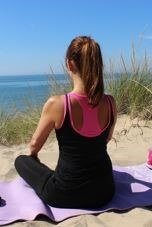
Breath of Fire
Breath of Fire is almost exclusively used in Kundalini yoga. It works a bit like hyperventilating through your nose, that is, breathing in and out rapidly. The movement is supposed to pump the navel chakra to awaken the Kundalini energy and move it upwards. If we think about an old-fashioned bellows that was used to light fires from a spark and keep them going while people cooked or forged iron in a blacksmith’s shop, for example, we will get the idea of how breath of fire should work.
Breath of Fire can be a bit tricky to master, but if you picture yourself as a happy puppy breathing in and out through the nose only, you should be able to develop a natural rhythm. Some yogis claim that 1 minute of breath of fire is the equivalent of miles of jogging or hundreds of sit ups.
Alternate Nostril Breathing
Alternate nostril breathing is used to keep the energies balanced in the body and to restore balance. We may not notice it, but our breathing can become uneven through both nostrils through things like colds, allergies and so on. This pranayama can help.
Sit comfortably with your spine erect and shoulders and face relaxed.
Place your left hand on the left knee, palm open.
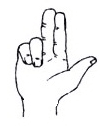
Using the pinkie and ring fingers of your right hand, position your hand according to the diagram above. Press those 2 fingers to your left nostril to close it.
Place the tips of your index and middle fingers on the third eye chakra, that is, the forehead just above the bridge of your nose.
Place the thumb on the right nostril lightly.
Breathe through the right nostril, taking long deep breaths, for at least 8 breaths. When you feel that the air is flowing freely, switch nostrils.
Now open the left nostril by moving the pinkie and ring fingers. Close off the right nostril this time using your thumb. Keep the index and middle fingers on your third eye chakra. Breathe in and out for eight, and then go on to the next activity, or repeat the cycle in each nostril 8 times each, for a total of 9 times. (72 in total)
As part of a Kundalini yoga set, your teacher will tell you exactly how long to do this breathing pattern by counting or by using a timer.
Long deep breathing.
This is done in a range of poses, most particularly with Corpse pose at the end of your yoga session. It can be a 1 to 1 pattern of 16 counts for the inhale or the exhale, or the 2 to 1 exhale pattern if you wish.
Now that you have mastered sitting postures and three of the main forms of breathing, it is time to look at the 4 locks in Kundalini yoga.
The 4 Locks (Bandhas) In Kundalini Yoga
Kundalini yoga is unlike other types of yoga because it uses 4 locks, or bandhas, to focus the energy at a certain chakra in order to drive it upwards through the central channel. All of these locks should be done with a straight back and no slouching if you wish to gain the full energetic effect. The 4 locks are:
- Root-squeezing the muscles around your anus and perineum. Women would be familiar with these as Kegel exercises, often done after childbirth. Pretend you are holding a piece of paper between your buttocks in the locked pose.
- Solar plexus or diaphragm lock. Breathe in as if you are drawing the front of your body towards your back. The easiest way to do this is to pretend you are sitting in a chair. Stick your butt out, bend your knees, and put your hands on the tops of your thighs. This will put tension on the area. Once you are familiar with the sensation, you should be able to apply this lock sitting down or standing upright as well.
- Neck lock. Tuck your chin in to align the head and make the neck straighter and less curved. You can gently push your chin into alignment with your fingers to remind yourself not to let your chin or neck sag when you are doing Kundalini yoga.
- Mahabandha. This translates as the great lock, and is comprised of doing all 3 of the other locks at the same time, root, solar plexus and neck. Certain kriyas will use mahabandha to keep the body aligned in order to keep the energy moving.

Now that you know about the 4 locks in Kundalini yoga, it is time to look at a few of the main mantras.
Mantras And Chanting In Kundalini Yoga
There are a number of mantras and chants in Kundalini yoga. Depending on your tastes, you might find them weird, or fun. In many cases, they have also been set to music by various artists associated with Kundalini yoga, to make it more interesting and rhythmical.

Om is the most common mantra (pictured above). The M sound can be quite nasal in Sanskrit, so in Kundalini yoga it is chanted as ONG. Some of the chants are in other Indian languages. Your teacher can do their best to translate for you if you wish to learn more.
As we have mentioned, most Kundalini yoga classes start with a tune in of ONG NAMO GURU DEV NAMO.
Some classes will also start with:
Aad Guray Nameh (pronounced NAM-AAY)
Chugaad Guray Nameh
Sat Guray Nameh
Siri Guru Devay Nameh
It is a protection mantra that means you are bowing to the infinite wisdom of the universe. It is a bit like asking for all your efforts to be blessed and all your goals to be achieved.
An essential one in Kundalini yoga is SAT NAM=I am truth. This is the main chant of the powerful Sat kriya, which you will learn in a moment. Sat kriya is one of the best ways to align the chakras to harness the power within.
Some mantras have mudras or hand movements that go with them. Let’s look at Kundalini yoga mudras in the next chapter.
Mudras (Hand Movements) In Kundalini Yoga
Most people who know anything about yoga are aware of three things, the lotus position, the mantra OM, and the hand gesture or mudra that goes with it. The hand is open to the sky apart from the index finger, the first joint of which is being pressed under the curled thumb to form an O-like shape. Gyan mudra is often used when chanting OM or meditating in order to improve mental focus and clarity.

Mudras are also thought to move energy along certain pathways in the body know as meridians. They are also a good way to focus. One of the best ways to focus energy in the body, such as in relation to the chakras, is to touch the area.
For example, OM is the mantra of the Third Eye Chakra, said to control wisdom and intuition. When you are doing alternate nostril breathing, you are stimulating the chakra by placing the tips of your middle finger and index finger there.

Put your hands together in the center of the chest as if praying. Bend the thumbs and press them into the center of your breastbone at the level of your heart. This can be done standing, sitting or lying down. Some people are even flexible enough to be able to do it behind their own back at the level of their heart chakra.
There are many other mudras in Kundalini yoga that you will learn as you go along, but these are the main ones to help you get started.
Now that you have learned about the breathing, locks, mantras and mudras that are particular to Kundalini yoga, it is time to look at some kriyas or sets for specific purposes.
Easy Kriya To Get The Energy Moving
This whole kriya only takes 22 minutes and is the perfect way to start your day.
Tune in with ONG NAMO GURU DEV NAMO 3 times.
Front Leg Stretches
Sit with your left leg stretched out straight in front of you; and place your right foot against the inner thigh of the left leg. With both hands, stretch forward and then down over the left leg. Hold on to the foot or as far down the leg as you can reach with both hands to get your forehead as close to your knee as you can without straining. Use long slow deep breathing. Hold for 2 minutes. Come back in and out as needed. Keep your chin tucked in. Repeat on the right side, 2 minutes.

Seated Side Stretches
Stretch your left leg out in front of you; place your right foot against the inner thigh of the left leg. Reach your left hand down to the shin, ankle, or foot of the left leg, whatever you can reach easily without straining. Place the right arm behind your back. Tilt the pelvis forward so that the chest lifts up.
Keep the chin towards the right shoulder. Do not let it flop. Gently fold from the pelvis, not the lower back, sideways over the left leg. You should feel a stretch in the left hamstring and the right hip. Use long slow deep breathing. Hold for 2 minutes. Come back in and out as needed.
Side Stretch Right
Use the same starting position as in the previous posture, sole of foot to inner thigh. Same as exercise #2. This time, spread the straight leg out wide. Fold over and to the side to feel the stretch throughout your torso. Hold the pose for 2 minutes, moving in and out of it as needed. Then switch legs so you are stretching to the left. Continue for 2 minutes. Repeat on the right side, 2 minutes.
Easy Camel Ride
Come into Easy Pose and grasp the shins above the ankles. Inhale as you lift the chest up high and tilt the pelvis forward. Exhale, round the lower back, and rock the pelvis back. Remember to lift the chest up high on each inhale and keep the chin level to the ground in both positions. Don’t let the head flop. Work at your own pace to whatever range of motion is comfortable. Continue for 3 minutes to work the kinks out of your back and let the energy flow.
Cross Crawl
Lie down on your back with the arms by your sides and your palms flat against the floor. On the inhale, bring the left knee to the chest and at the same time, bring the right arm up and over your head until it lies flat on the floor, forearm to mat. Exhale into the starting position and repeat with the opposite leg and arm, right knee into the chest, left arm stretched out above your head. Concentrate the breath around the level of the navel center. Continue for 2 minutes, alternating sides. Try to keep your lower back on the mat and avoid twisting the body.
Cat-Cow
Come onto the hands and knees, with your hands shoulder-width apart, fingers pointing forward. Your knees should be squarely under your hips. Exhale and tilt the pelvis downwards and the small of the back upwards like an angry cat arching its back, head down, chin into chest. You can mentally hiss like a bristling cat if this helps you remember the position. Inhale and tilt the pelvis in the opposite direction, so you have a sway back and your chin is upwards, head facing up. You can mentally moo if this helps you remember.


Move fluidly from cat to cow and back to cat again as smoothly as possible with no jerking. The movement should feel natural, not forced or strained. Continue for 2 minutes and feel all the blocked energy being released.
Child pose

From cat-cow, sit back on your heels to Child pose. Place your forehead on the ground and stretch, wiggle and do whatever feels nice. Then move the arms to your sides, hands near the ankles, with your palms facing upwards, forehead still
on the mat. Allow the shoulders to relax. Breathe normally and hold this pose for 90 seconds.
Washing Machine

Come into Easy Pose. Grasp the shoulders with the 4 fingers in front and thumbs in back, right hand to right shoulder, left hand to left shoulder. Don’t tense up the hands. Inhale and twist the torso to the left. Exhale and twist the torso to the right. Keep the chest up high and let the head travel with the shoulders. The elbows should be out and the underside of your upper arms parallel with the floor to maintain the form as you twist back and forth. Don’t let yourself slump or slouch. Continue for 90 seconds.
Shoulder Rolls
In Easy pose, place the hands on your lap or thighs, palms down. Roll the shoulders in big, slow, smooth circles from back to front. Breathe normally.
Continue for 1 minute.
Roll in the opposite direction from front to back for 1 minute.
Deep Relaxation Corpse Pose 3 minutes
Tune out with SAT NAM 3 times and get on with your busy day feeling great because you are so full of energy naturally flowing in your body without getting stuck.

You can use this kriya every morning before you shower and before you eat anything to start the day off right. If you want to ‘ground’ you energy so you are not too bouncy afterwards, you have 2 choices.
1. Finish off your shower with cold water on your hands and feet, tops and bottoms.
2. Use a homemade salt scrub with 1 part olive oil to 2 parts Kosher salt and a drop of peppermint essential oil if you wish. Scrub your hands and feet. Then rinse with cold water. Note that the oil can be a bit slippery on the soles of your feet, so do one at a time and then step out of the shower onto your bath mat. Only use the scrub every 3 days to avoid too much abrasion.
Now that you know how to move your energy, let’s look at a kriya to boost your vitality.
Kriya to Balance Chakras
Wrapped Chair Pose with Breath of Fire
To do this pose, begin in a standing position. Start is if you are going to do regular chair pose by sticking your rear out as though about to sit on a chair.
Instead of raising the arms overhead, bend forward slightly so you are squatting with your arms in between your legs.
Wrap your arms behind your ankles, palms on top of the feet, note the placement of the hands in the image above. Keep the back straight. Lift the head and look forward. Do Breath of Fire for 5 minutes.

This will require good balance. You can come in and out of the pose as needed, or if you fall forward or backwards. If Breath of Fire is too intense, go back to regular breathing at your own speed.
Sat Kriya
Sit in Rock pose, or easy pose if you really can’t manage it.
Bring your arms straight overhead and fold all of the fingers into one another, interlaced apart from the 2 index fingers. They should be pressed together and pointing straight up to the sky.
Your upper arms should be hugging your ears and there should be no bend in the elbows. You should have your chin tucked in for neck lock and your diaphragm tucked in for solar plexus lock.
As you chant Sat, you will tighten your root chakra and navel point.
As you chant Nam, you will release your root chakra lock. The pattern will come naturally after a while, inhale and lock, exhale and release. Don’t try to force it. As you squeeze the root chakra, your voice will go up, and sound like SUHT, and when you exhale, it will sound the Nahm. This will tell you that you’re getting your locks right. Go at a natural, comfortable pace, not too fast. 5 minutes


Sitting in Rock Pose on your heels, rest the hands on the thighs
Begin Sitali Pranayam, inhaling through your mouth, which should be shaped like an O with your curled tongue resting inside the O like you are trying to make a straw with it.
Breathe in through the O and hold. Rotate the hips around in a circle. Rotate to the left for 1/2 the duration of the held breath. Then hold and rotate to the right for 1/2 the duration of the held breath. Exhale and start again for a total of 3 times. You should have a good sense of how long you can hold your breath comfortably, such as 40 seconds, in which case, circle the hips to the left for 20 seconds and the right for 20. The pranayama and circles will raise energy and improve breathing.

In the V for Victory Pose, also known as Boat Pose, shape your body like a V. Your legs and feet will be off the ground at a 60° angle. Your back will be raised off the floor at a 60° angle, arms straight out towards your knee with you balancing on your butt.
Inhale. Like a reverse sit up, lower both the back and legs to a 45 degree angle.
Exhale. Sit up to 60°. Do this for 1 to 5 minutes. This will give great abs and is said to be the equivalent of 8 hours of working out. If you are struggling to keep the legs in the air, you can bend the knees so they are close to the chest. If you still struggle, you can also grip the backs of the knees with both your hands. Shake it out at the end of the pose.
The aura tummy rub
Lie on your back and bring the hands to the region of the Navel Point.
The left hand should be closest to the body and the right hand is over the left, with 2 inches of space between the body and the palm of the left hand, and 2 inches between the top of the left hand with the palm of the right hand. Everything is stacked above each other. Start to circle both hands in a clockwise motion. Concentrate. Avoid letting them touch each other or the body.
Use long deep breathing. 3 minutes.
Remain on your back and extend your arms up to 90°, straight above your chest. Make fists of your hands and with great tension, pull your fists into your chest like you were doing a chest press in weight lifting. Release and repeat 2 more times.
Remain on your back with your left hand on your heart and the right hand over the left. Use long deep breathing and the mantra Hum Dum Hari Har, Hari Har Hum Dum. It translates roughly as divine is my breath, my breath is divine. 3 to 5 minutes.
Sit up into Rock Pose
Place hands in Bear grip; imagine a grizzly with strong paws. The left palm should face out from the chest with the thumb down, 4 fingers curled.
Now place your right hand with the thumb up, palm facing the chest. Curl the 4 fingers and hook them into the curled fingers of the left hand. Pull slightly against the finger so you feel some tension in the arms. This might be a bit painful for your fingers if you have long nails, but just do the best you can.

Elbows should be out and bent. Start to move your elbows up and down quickly like joined windshield wipers, or the propellers of an old-fashioned airplane. Keeping your gripped hands at the heart chakra level. Use normal to rapid breathing synchronized with the movement. Inhale, left elbow goes up, right goes down. Exhale, left goes down, right elbow swings up.
Keep back straight; do not slouch forward or back. 5 to 11 minutes.
Remain in Rock pose, place your palms on your thighs and begin turning your head only to the left on the inhale and to the right on the exhale. Keep your chin tucked in a little so your head does not wobble all over. Do not twist at the waist or turn your shoulders. This is a good workout for your throat chakra. 3 minutes.
Move to Easy Pose and bring the hands up to the face with the thumbs pressing on the temples. The fingers will be about 2 inches from the face as though you are shielding your eyes from the sun. Roll your view so it is gazing up to the Third Eye Point. You should feel some pressure in the eyes and above the bridge of your nose.
Now chant aloud or mentally Har Wahe Guru, Har Sat Nam. The translation is roughly joy in the teacher within, joy in living the truth. This mantra is said to relieve all physical pains. 3 to 5 minutes.

Sit in Celibate pose, knees spread, buttocks between heels. Relax down towards the floor with your back, hands on the floor at your sides or between the thighs to support you so you do not go too far/collapse backwards. Hold the pose as long as you can, but not so long that any part of your body falls asleep. 3 to 5 minutes is plenty for beginners, up to 11 minutes.
Release yourself from the pose carefully and shake out your legs. Then relax on the back in corpse pose for. 11 minutes.
This should align all your chakras and give you great strength and vitality. As a beginner, you can aim for the lower end of the suggested time, but as you get stronger, you should be able to do each pose for the full duration of the upper limit suggested.
Since this is a very powerful kriya, you should only do it every few days. Alternate with the other kriyas to give your muscles a rest. You can also do long deep breathing and Sat Kriya for a few minutes each day as your yoga session.
Reminder, always tune in and shake yourself out/cool down, then tune out. Above all, be respectful to your body and listen to it. Don’t try to force yourself or think, “No, pain, no gain.” Pain is the body’s warning sign, so pay attention to it rather than trying to impose your will and ending up with an injury that might force you to halt your practice for several days.
Conclusion
There are many forms of yoga available, from traditional Hatha to the more modern inventions of Bikram. Yogi Bhajan may have brought Kundalini yoga to the West in the late 1960s, but it is a traditions stretching back more than thirteen hundred years. It has lasted this long because, quite simply, it works. Best of all, it works for anyone, young or old, in good health or with health issues. Everyone can do the best they can and go at their own pace as needed. Just accomplish what you feel you can in each of the suggested time frames per pose or kriya.
Kundalini yoga is the only form of yoga that is specifically designed to awaken the power within, physical, mental and spiritual. Everyone who practices it can gain a healthier body, a more perceptive mind, and deeper understanding and wisdom. This wisdom understands no man is an island (or woman either), but that we are all connected to each other and to every living being.
It is through the asanas, mediation and breath work that we can achieve mindfulness and the appreciation of all we have, and begin to move towards being all that we can be. The energy released can also be the gateway to higher realizations on the Tantric path to enlightenment, in which the material world can be used to gain spiritual attainments.
There is no need to feel ‘stuck’ in your life when a few simple Kundalini yoga poses or kriyas can unblock your energies and lead to powerful transformations of body, mind and spirit. Try the kriyas in this guide and see what a difference they can make to your health and vitality.
Free tool
Meditation Timer — time your kriya and meditation with interval bells.
Frequently asked questions
Is Kundalini yoga safe?
For most people, yes. Rapid breathing (Breath of Fire) can cause dizziness; avoid it if you are pregnant, have high blood pressure, heart disease, epilepsy or a hernia, and stop if you feel light-headed. Some people find intense meditation emotionally unsettling, so build up gradually.
How is Kundalini different from Hatha yoga?
Hatha focuses on holding physical poses. Kundalini uses repetitive movement, intense breathing, chanting and meditation, with poses often held for set times of 1–3 minutes or more.
Do I have to chant?
Chanting is part of the tradition, but you can listen silently while you get comfortable with it.
How long is a Kundalini session?
Classes are usually 60–90 minutes, but a single kriya at home can take 15–30 minutes.
Related: types of yoga, yoga for beginners and yoga for health.
This article is for general information and isn’t a substitute for advice from your doctor or another qualified health professional. Check with them before starting a new exercise or eating plan, especially if you have a health condition, are pregnant or take medication.