Yoga is one of the most researched mind-body practices. Studies suggest it can help with back pain, arthritis, stress, sleep, blood pressure and balance, and it adapts to almost any age or fitness level. This guide explains how yoga supports health, the styles and breathing techniques that suit different needs, how to practise safely, and specific approaches for 16 common health issues.
Key takeaways
- Yoga combines postures, breathing and relaxation; all three contribute to its health benefits.
- Gentle styles (Hatha, Restorative, Yin, chair yoga) suit most health conditions best.
- Evidence is strongest for low back pain, stress, anxiety, balance and quality of life.
- Check with your doctor first if you have a medical condition, are pregnant or are recovering from injury.
- Yoga complements medical treatment; it doesn’t replace it.
What Is Yoga?
Derived from the Sanskrit word “yuj” which means “to unite or integrate,” yoga has been practiced on the Indian subcontinent for more than 5000 years. It is now an integral part of traditional Indian medicine, Ayurvedic medicine. Yoga poses, movements and meditations are a means of improving body, mind and spirit, bringing them into union with one another for better overall health and wellness.
Yoga is all about harmonizing the body with the mind and breath through the means of various breathing techniques (pranayama), yoga postures (asanas) and meditation. In some cases there might also be hand gestures (mudras) and chanting (mantras).
For example, most people who know anything about yoga know gyan mudra, forming a circle with the index fingers and thumbs of each hand, with the first joint of the index finger underneath the thumb. They also know the mantra OM. Both gyan mudra and OM help focus the mind and improve concentration during yoga practice.
Certain types of yoga emphasize perfect asanas, while others focus on moving the energy in your body so you can access it like tapping into an inner battery to achieve what you wish in life. Still others are physically demanding in order to lose weight or get as fit as possible as quickly as possible.
In this guide we will be looking at yoga that anyone can do, no matter what their age or level of fitness, for the purpose of dealing with specific health and fitness issues. If you are struggling with arthritis, chronic pain, or depression, there are yoga poses and meditations that can help. If you want to increase strength, balance and flexibility, all yoga poses can help with this. You will be able to avoid slips, trips and falls and any broken bones that may result, keeping you mobile instead of stuck in a bed or chair.
In terms of fitness goals, you might be struggling to lose weight. You might also wish to get better abs, or a more solid core, in order to improve strength and posture and relieve back pain. Best of all, you don’t even have to leave your house to get a great workout with yoga once you know how.
It is fun to take a class to learn from the teacher and socialize with others, but if you don’t have time, are on a tight budget, or live in a place where the nearest studio is miles away, you can still get a great yoga workout at home. There are DVDs and online lessons, great websites full of photos of poses and advice, and much more, to help you expand and deepen your practice to achieve the kind of results you are looking for from the yoga poses you do for your specific health goals. The poses you will find in this guide will also be suitable for a regular daily yoga practice to stay fit.
Now that you know what yoga is, it’s time to look at all the benefits of yoga for your health and fitness.
Benefits of Yoga For My Health And Fitness
A regular yoga practice can awaken the power within and become the gateway to the kind of life you’ve been dreaming of. There is no need to feel stuck in a rut when yoga can open up all sorts of possibilities in your life even as you open up body and mind.
Yoga increases:
o Physical Wellness
o Energy Levels
o Flexibility
o Range of Motion
o Long Lean Muscle
o Stamina
o Mental Abilities
o Memory
o Concentration
o Self-Esteem
o Strength
o Pride in One’s Efforts
o Cell Rejuvenation
o The Strength of Your Immune System
o Social Skills if You Attend Classes
A regular yoga practice decreases:
o Anxiety
o Stress
o Tension
o Depression
o Weight
o Muscle Wastage that comes with age (having a frail, bird-like appearance)
o Blood pressure
o Blood sugar
o Cholesterol
o Arthritis Pain
o Joint Stiffness
o Cell Death
o Cell Mutation
o Thyroid Issues (especially slow thyroid, which can lead to weight gain)
o Muscle Pain
o Loneliness
o Mind Fog, poor memory
Sounds great, right? It is! So let’s look next at some of the most popular kinds of yoga that you are most likely to find in the studios near you if you live in or close to a moderately sized city.
Mountain pose with raised arms
Types Of Yoga For Different Health Challenges
Free tool
Yoga Style Quiz — find the style that fits your goals and health.
The pro-yoga movement that kicked off in the West from the 1940s onwards has resulted in a range of adaptations of traditional yoga styles and all-new inventions claiming to be yoga.
Here are some of the most common forms of yoga you will be most likely to find in any studio near you. The best 3 if you have any underlying health issues are:
Hatha
Hatha yoga is the most traditional of the yogas. The name means willful or forceful, and the word is a combination of hat, sun and ha, moon. It works with the energy centers of the body, as well as the flesh and bone for a balanced body. The main focus is on surrendering to and perfecting the many poses. There are levels of practitioners who can do increasingly difficult poses for flexibility. But there is no need to turn yourself into a pretzel to get a great workout. The basic poses can boost your fitness in a short period of time.
Kundalini
Kundalini yoga focuses on awakening the power within, both mental and physical. It is termed a Ôhouseholder’s’ yoga for ordinary people who need energy, focus, concentration and healthy balance in all aspects of their lives. The farmers and their wives in northern India need something that would work quickly so they could get on with their grueling day, so it is perfect for us in the modern world too.
Kundalini yoga has some postures that are not found in any other forms of yoga. These poses, or asanas, are specifically designed to move energy up the spine and the main energy channel of the body in traditional medicine, which is known as the central channel.
Kundalini yoga has been practiced since the 8th century for its transformational effects. It was brought to the West by Yogi Bhajan, who also founded Yogi tea, in the late 1960s, and has now spread to hundreds of studios in dozens of countries.
Vinyasa
Vinyasa yoga is also known as flow yoga. It uses the same asanas as hatha but they are put into a sequence whereby the body is in constant motion as it moves smoothly from one pose to the next. Vinyasa became a trend in the latter part of the 20th century to link the poses together in a fluid way. The word vinyasa means Ôbreath-synchronized movement’, with the asana being performed in conjunction with inhale and exhale patterns.
No matter which of the three you choose, the important thing is to set your goals for what you wish to achieve through yoga. Starting a yoga journal and keeping track of your workouts, weight, and feelings about your practice and certain poses is one of the best ways to stay on target and make the most of your practice.
In this guide, you will find poses and sets from all three of these styles of yoga. But before we get started with the poses, let’s look at 2 important elements in starting yoga, breath work and putting safety first.
Breath Work In Yoga (Pranayama)
Free tool
Breathing Exercise — follow guided box, 4-7-8 and slow breathing patterns with a visual pacer.
Breathing is an essential part of yoga. Breathing, or pranayama, helps move energy around the body. It can also cleanse, detoxify and offer healing in a range of ways depending on the pattern of the breathing.
There are three aspects of our breathing we need to consider in relation to pranayama.
1. Inhale
2. Retain
3. Exhale
Controlling each of these will give us different effects. Here are some of the main breathing patterns you will find in most forms of yoga.
Long Slow Deep Breathing
Lie on your back (Corpse pose).
Begin by observing the natural inhalation and exhalation of your breath without changing anything. If you find yourself distracted by the activity in your mind, try not to engage in the thoughts. Bring your attention back to the breath.
Inhale deeply through the nose, filling the diaphragm and belly like you are blowing up a balloon. Hold the breath for a few seconds, then exhale through the nose, pushing all the air out at the end of the exhale like you are squeezing all the air out of the balloon. Repeat for 5 breaths.
This is a great exercise for anyone with breathing issues.
4/4 breath
Sit cross-legged (Easy pose)
Begin a slow count to four as you inhale.
Count to four as you exhale.
The exercise is to match the length of your inhale and exhale.
You can also add a retention for a count of 4 before exhaling. In addition, you can hold the breath out for 4. The first will circulate energy through the body. The latter will help you get rid of stale air in the lung and toxins.
Alternate nostril breathing
Alternate nostril breathing is used to restore energy balance and maintain it.
Sit comfortably cross-legged with your spine erect and shoulders and face relaxed.
Place your left hand on the left knee, palm open.
Position the right hand like the diagram above.
Using the curled pinkie and ring fingers of your right hand, press them to your left nostril to close it. Place the tips of your straightened index and middle fingers on the third eye chakra, that is, the forehead just above the bridge of your nose.
Place the thumb on the right nostril lightly.
Breathe through the right nostril, taking long deep breaths, for at least 8 breaths. When you feel that the air is flowing freely, switch nostrils.
Now open the left nostril by moving the pinkie and ring fingers. Close off the right nostril this time using your thumb. Keep the index and middle fingers on your third eye chakra. Breathe in and out for eight, and then go on to the next activity, or repeat the cycle for a total of 9 times.
Breath of Fire
This is the breathing used often in Kundalini yoga order to move energy up the body from the lower body to the top of the head.
Sit cross-legged (Easy pose).
Start breathing in and out through the nose rapidly, as though hyperventilating.
As you breathe, the movement should pump the navel area.
If you have trouble starting or sustaining the breath, picture yourself as a happy puppy panting in and out but through the nose only, you should be able to develop a natural rhythm and will get good abs very quickly. If you feel dizzy, go back to long, deep breathing.
Cooling Breath
This breath has a calming effect.
Sit cross-legged (Easy pose).
Form your mouth into an O.
Curl your tongue so it is resting inside the O.
Breath in through the tongue and out through the nose. Repeat 10 times.
This is a great exercise for anyone with breathing issues, particularly asthma and Chronic Obstructive Pulmonary Disease (COPD).
Segmented Breathing
Sit cross-legged (Easy pose) in most cases.
This is sniffing the breath either in or out to a particular count, such as 8 sniffs in and eight blows out.
Any of these breaths can be used as warm ups for your practice, and some like long deep breathing, 4/4 breath or cooling breath can be part of your cool down after your work out.
Now that you know about the main patterns of breathing in yoga, let’s look at some of the main safety considerations when starting yoga.
Triangle pose
Safety First When Doing Yoga
Free tool
Warm-Up Generator — a gentle warm-up before your practice.
There are a number of safety considerations in relation to any form of exercise.
See your doctor first
Since this guide is all about yoga for health and healing in relation to particular medical conditions you may be suffering from, your first step is to consult with your doctor. Review your medicines, pain relief strategies, and so on. Note your discussion in your journal.
Follow up with your doctor
Check back in with your doctor to report on progress and goals. If you have set a weight loss goal, for example, track your progress in your journal.
Start slowly
If you have not worked out for a while or have a musculoskeletal issue such as arthritis, start slowly and gradually increase your efforts. Don’t overdo it your very first session, get injured, and have to stop your practice.
Listen to your body
Know your limitations-pain is NOT gain with any exercise, and certainly not with yoga. Pain is a sign that something is wrong and needs to be investigated.
Watch your form and posture
Imitate what you see in photos and on DVDS, but pay attention to your back and knees. Do most bends with a flat back, for example, not a rounded one, and avoid locking your joints such as your knees completely unless specifically told to do so.
Don’t compare with your past self
One of the most common but potentially serious mistakes seniors make when returning to exercise is to think, ÒWell, I used to jog 5 miles a day easily.Ó That was the, this is now. Your body is different, and most likely your weight and overall level of fitness as well. Plus, jogging might have been fine for a younger body but is far too high-impact for most seniors. Luckily, yoga is low impact and safe when it is done sensibly.
Warm up before
Warm up before a yoga session as you would for any other form of exercise in order to avoid injury. Simple stretching and easy poses are ideal.
Cool down after
Cool down after each session to avoid injury or cramping. Stretching and easy asanas and breathing exercises are good for this as well.
Don’t eat for 2 hours before the practice
Some of the poses can be very intense and affect your digestion.
Stay hydrated
Drink plenty of fresh water before, during and after your practice.
Rest as needed
It is fine to come in and out of a pose or just stop to rest for a while. If you are working out at home, set your own pace. If you are at a yoga studio, don’t worry about what others think. The only person you have to worry about is yourself.
Precautions for women
Women should not practice certain yoga poses such as inversions (hips over head) during their menstrual period or pregnancy.
Since safety is all-important, it is best to stay clear of any studio or teacher that practices Bikram. Also known as hot yoga, the roasting temperatures of Bikram are not recommended for anyone who has a heart condition or breathing issue, or any other disorders. The workout is too vigorous for most beginners as well, even leaving aside the hellish conditions in the studio, which range from 80F to 110F with a humidity of 75%.
Now that you have learned the essentials regarding safety considerations, it’s time to learn poses that can help relieve the various health issues that might be affecting you.
Dolphin Plank
Yoga for Common Health Issues
There are thousands of yoga poses, but some are basic ones that are useful not only for any yoga style, but also for a range of health issues. Whenever possible, we have chosen a basic pose or a Ôsuper pose’ that conveys more than one health benefit.
As you move from one pose to the next, rest as needed, drink water, wiggle and so on. Listen to your body and pace yourself.
We will discuss poses and flow sequences for the following medical conditions:
- Arthritis
- Back Pain
- Chronic Fatigue
- Chronic Pain
- Depression
- Diabetes
- Flat Abs
- Headache/ Migraine
- Heart Health
- High Blood Pressure
- Insomnia
- Osteoporosis
- Stress and Anxiety
- Strong Core
- Weight Loss
Arthritis
More than 350 million people worldwide have arthritis, with about 40 million Americans suffering from it, including around 10 million children. There are 2 main types of arthritis, osteoarthritis (OA) and rheumatoid arthritis (RA).
OA often comes with age, due to wear and tear on our bodies and the Ôuse it or lose it’ issue-if you want to stay fit and healthy, you have to remain active and do cardio exercises that speed up the heart and above all, weight-bearing exercises that maintain strength, muscle tone and stable joints.
RA is the result of excessive inflammation in the body that causes it to start destroying itself. RA mostly affects women from their late 30s to their 60s, causing severe pain and joints such as the hands starting to become gnarled and twisted.
Exercise is essential for those with RA. Yoga is a safe, low-impact weight bearing exercise that can help keep your joints strong, and reduce inflammation too. Here are some very useful poses for arthritis anyone can do. They are also ideal for beginners who want to maintain their flexibility. We have put it into a flow sequence because it is so important to help you keep moving even with arthritis.

Mountain Pose
This is the basic standing position in yoga. Even though it might seem simple, it is a weight-bearing pose good for bones and joints. Plant your feet solidly, even weight on both feet, back straight, abdominal muscles engaged, arms relaxed. Use this pose for warm up, long deep breathing, or a starting or finishing pose in a flow sequence.

Chair
From Mountain, raise your arms up in the air, and your butt downwards, bending at the knees as if you were going to sit on a chair. Hold this pose as long as you can, then come back up. Do 2 or three and move back to Mountain.

Triangle
From Mountain, step one leg out to the side widely as if doing a jumping jack without the jump. Using the arm on the same side of the body as the outstretched leg, bend sideways to try to grip the leg or ankle. Hold for 15 seconds. Repeat 2 more times. Then return to Mountain and step out with the opposite leg and bring the opposite arm down.

Standing Forward Bend
From Mountain, fold your body over from the pelvis as if trying to touch your toes and bring your head to your needs. Hold and breathe. Wiggle if you need to. Then bend your knees to sit cross-legged, Easy pose.

Kundalini Spinal Twists
In Easy pose, place your hands on your shoulders, right hand to right and left to left, thumbs at the back, the other 4 fingers at the front. Inhale and twist slowly to the left. Exhale and twist slowly to the right. These are Kundalini spinal twists, also referred to as the Washing Machine because you look like the central agitator in a top-loading washing machine as you move back and forth. This is great for flexibility and detoxification. Work at your own pace. You should gradually be able to improve your range of motion and pick up speed.

Cobbler Pose
This is also known as Butterfly pose. Sit on the floor and bend your knees, opening then to the sides so the soles of your feet touch. Move them in closer or further away from the body, whatever feels most comfortable. Breathe into the pose and hold it for about 30 seconds. You can gently move the knees up and down, but never try to shove them down.

Bound Angle Pose
From Cobbler/Butterfly, grip your big toes by wrapping your index fingers around them. Lean forward so your back is straight but your body is now leaning towards your knees. Hold and breathe, then release and shake out the legs and knees before moving on to your next pose.


Cat-Cow
This is a pair of poses always done together to stretch the spine and build solid core muscles. Come onto your hands and knees with your head up. This is Cow pose. Now bring your head down and arch your back like an angry cat hissing. This is Cat pose. Move from Cow to Cat, Cat to Cow, at your own pace, feeling the effects on your back. Start slowly and don’t try to overdo it. Gradually, you should start to notice your range of motion improve and feel a lot less stiffness and pain.
These are most popular poses which can be used for a range of health conditions and as part of a good daily yoga practice for exercise. If you want to learn more about yoga for arthritis, the Arthritis Foundation has a list of useful videos to help you add yoga to your daily life safely and sensibly.
Back Pain
Up to 80% of adults in the US will experience back pain at some point in their lives. Others suffer from chronic back pain. Many of us spend so much time sitting at a computer that our posture and spine start to suffer. If we do not have solid core muscles to support us, pain can result.
Also remember to always lift any heavy objects safely and sensibly, squatting down near it, gripping it firmly and then using your leg muscles to raise it off the floor. Do not bend over it and then try to pick it up with your arms. Also avoid twisting from side to side if you have a heavy weight in your arms.
What are some of the poses to help with back pain? Here are a few suggestions that can be used for other health benefits as well. They are in a flow sequence to keep you moving and your back flexible, your core solid.
Start with Mountain.
Raise your hands above your head, Mountain with raised arms.

Move the palms to face each other. Step one leg forward, keeping both arms above your head. This is Warrior I pose. Hold for 15 seconds.

Now lean backwards gently and bring the arm on the same side as the back leg down to that leg. Warrior-Reverse.
Return to Mountain pose and step to the front with the opposite leg. Hold Warrior I. Move to Warrior-Reverse, then back to Mountain.

From Mountain, step out forward again with one foot, but this time, position the arms so they are about shoulder-height and parallel to the floor. The front arm should match the front leg, and the back arm should match the back leg. Hold and breathe. This is Warrior II.
Return to Mountain and switch sides.
Return to Mountain, then step out to the side to do Triangle. Hold for 15 to 20 seconds. Return to Mountain and then step out with the opposite side.

Step to the side as though doing a jumping jack. Bend forward from the pelvis to bring your hands and the top of the head if possible. This is Standing Wide-Legged Forward Bend. Hold this position for 10 to 20 seconds, breathing into your back as you do so.

Step the foot into the side so they are close together and balance the weight of your body on the hands and feet. Wiggle as needed to get comfortable. This is Downward dog. Hold and breathe into the posture, feeling your spine stretch.
Bend your knees and go to Cat-Cow. Move in a smooth motion from one pose to the next. Feel the spine release. If you experience any pain, stop.
In this chapter you have learned ten ideal poses for back pain, and as you have seen, many of the ones you learned in relation to arthritis are also good for back pain.
Chronic Fatigue Syndrome
Chronic Fatigue Syndrome or CFS used to be consider a myth or ‘laziness’, but in the past few years, medical professionals have set diagnostic criteria for this misunderstood condition. All us get tired from time to time, but chronic fatigue lasts every day and is so severe that it affects a person’s ability to do their activities of daily living (ADLs) such as getting dressed, cooking and eating, shopping and work.
If you think you have CFS, the main criteria for a medical diagnosis are:
- A fatigued feeling for over six months. The fatigue often worsens with activity and doesn’t improve with rest.
- Pain in the bone, joints, or muscles
- Whole body listlessness, feelings of exhaustion, the inability to exercise
- Feelings of faintness, overwhelming tiredness, dizziness, exhaustion, lightheadedness, or the inability to get up and get moving
- Sleep issues, such as excessive sleepiness, not being able to sleep (insomnia), sleep disturbances such as waking in the middle of the night or not being able to stay asleep for long
- Mental impairment such as forgetfulness, a lack of concentration, brain fog
- Mood disorders such as nervousness, anxiety or worry without any known cause.
Other common symptoms that might indicate you have CFS are:
- Confusion
- Frequent headache
- Muscle weakness
- Sensitivity to pain
- Persistent sore throat
The good news is even people with CFS can find the energy to do yoga, and exercises like yoga can boost energy levels. As we have discussed, yoga is perfect for aches and pains from arthritis. As will discuss later, yoga can also help with sleep issues.

Big Toe Pose – Fold over as with Standing Forward Bend, but curl your fingers to hold the big toes, or and lay them flat under the toes of your feet.
Move to Bound Angle and then to Child pose.

From Child, go to Cobra. Raise off your heels and move forward with your hands until you are face down on the mat.

Cobra Pose – lay on your stomach and gently ease your upper body backwards using your hands. Do not lock the elbows. Look straight ahead and picture yourself as an angry snake hissing.

Corpse Pose – lay flat on your back, palms facing upwards.

Dolphin – This is similar to Downward dog, but you are bringing your forearms down to the floor to lean on them.

Happy Baby
Lie on your back. Ben your knees to bring them close to the chest. Grip your big toes on each side with each index finger. Spread your legs wider to stretch arms and legs. You can roll back and forth on your back if you wish, like a happy baby.

Locust
From Cobra pose, relax your arms at your sides for a moment so you are face down on the mat. Then lift the body up by tightening and stretching it so the legs and shoulders are off the floor, arms parallel with the body and stretching from the shoulders, fingers pointing down towards the feet. Hold as long as you can, then relax. Try a couple of more times and relax.

Seated Forward Bend
Fold forward from the pelvis. Try to grip your angles or toes.
Standing Forward Bend
Remember, always fold forward from the pelvis, not the small of your back, and reach for your toes.

Upward Dog – this is similar to Cobra, except your arms are straight at the elbows and you are engaging the tops of the feet against the mat in order to raise your legs up off the ground. Start in Cobra and push up carefully until your arms are straight, elbows soft, not completely locked.

Standing Wide-Legged Forward Bend-in Mountain pose, step out to the side like you were doing a jumping jack. Bend forward to bring your hands to the mat and the top of your head too. Hold and breathe for 10 seconds. Then bring one foot toward the other and do either Downward dog or Dolphin.
Try a couple of these poses and journal about how you felt after each one. Track your energy level with 0 being totally fatigued and 10 feeling good, and chart what a difference these poses can make to your energy level.
Chronic Pain
Yoga is great exercise with many health benefits, but there is more to yoga practice, as we will discover in relation to dealing with chronic pain. There are several poses that can help, but chronic pain can often be effectively relieved through yoga meditation. Let’s start with the poses and move on to the meditations. This is a flow series you can use every day to see how much it improves your well-being.
Mountain Pose
Ground yourself by planting your feet solidly and breathing in deeply for a few moments.

Eagle Pose
Yes, this is one of the stranger poses you will ever try, but it offers stretching to ease stiffness and tension and forces you to focus and concentrate. This mental concentration can lead to pain relief because you are thinking intently about something other than the pain.
This is a complicated pose, so let’s break Eagle down into the steps you need to do it correctly and safely. You may wish to try it near a wall if you are worried about losing your balance.
- Stand up straight in Mountain pose.
- Bend your legs at the knee.
- Lift your right foot off the ground.
- Balance your body on your left foot.
- Point the toes of your right foot towards the ground.
- Wrap your right foot around the calf of the left leg.
- Press the left foot on the ground to stabilize yourself.
- Stretch your arms in front of you now so they are and parallel to the ground as if you are a zombie.
- Cross your arms at the elbows, the left arm over the right.
- Bend your elbows and bring the arms parallel to your body so that the fingers are pointing towards the ceiling.
- Press the backs of the hands against each other.
- Twist your forearms further and try to bring both the palms to face each other.
- Place the fingers of the right hand in the palm of your left hand at the root of the thumb.
- Press the palms together as much as possible.
- Lift your elbows until they are level with your shoulders.
- Hold the pose and breathe normally for about 15-30 seconds.
- Repeat the same with your legs and hands in reverse positions.
Keep working on this one and you will be amazed at the difference it can make to your flexibility, relieving pain and stiffness.
From Mountain, fold over into Standing Forward Bend.
From Standing Forward Bend, step your feet back to Downward dog.
From there, step your feet back further until you are at the up position of a push up. This is Plank pose.
Lower yourself further to the ground into a low push up. This is Chaturanga.
Move down to Cobra pose.
From Cobra, move back to Locust Pose.
From Locust, move back to Cobra.
From Cobra, sit back on your heels, arm stretched in front, forehead resting on the mat, Child pose. Breathe in deeply and feel the tension ease in your neck and lower back. Stretch your arms out, wiggle, whatever you need to feel more at ease.
Corpse pose
The ideal pose to relax in as you do your meditations. Just make sure you are mindful enough to not fall asleep!
Yoga Nidra Meditation
Free tool
Meditation Timer — a quiet timer with interval bells for Yoga Nidra and meditation.
Yoga Nidra translates as the sleep of the yogis and is a way of improving your ability to meditate, and to gain inner wisdom. It is easy to do, but very powerful for relieving a range of physical issues and mood disorders. It should help you manage any chronic pain you might be suffering from.
Lie back into Corpse pose and get yourself comfortable. Some people like a small neck pillow under them and a light blanket over them depending on how long they will be meditating. Cold muscles also lead to pain and tension, so if you are not going to use a blanket, put on a sweatshirt and sweatpants or similar to make yourself more cozy.
1-Close your eyes. Notice your environment, sounds, smells, and taste. Release the tension from your body into the floor.
2-Set your intention. What do you want to accomplish in this session? Lose weight, relieve stress and so on.
3-Visualize yourself achieving that goal. Picture what your life will be like if you reach your goal or attain your desire.
4-Connect with your inner self.
Take a few moments to relax and calm both your body and mind. As you feel the calm wash over you, note how it feels. Then remind yourself that if you are ever stressed or feeling intense pain, you can summon up this feeling of inner calm no matter where you are.
5-Scan your body.
How does it feel? Note any pain, tension or stiffness. Start at the top and work your way down to your feet and right and left as you work your way down. Feel the energy level in your body overall. On a scale of 0 to 10, with 0 being a flat battery and 10 fully charged and ready to go, which do you feel?
6-Start to take notice of your breath.
Don’t do anything to control it, but feel the sensation of it curling in and out past your nostrils. Feel the rise and fall of your chest and notice if you are holding your breath, or if it feels uneven, such as your right nostril being stuffed up, and so on.
7-Observe your thoughts
Are you worried, stressed, angry? Notice the thoughts, but don’t follow them. They are just like waves in an ocean, rising and falling back. They are not a huge storm to worry about, and the little waves can never destroy the ocean.
8-Feel happy
We may think we have a hard life, but if we cultivate an Ôattitude of gratitude’ we can feel how fortunate we really are. Breathe in all the pain and suffering of others and breathe out pure joy and light for the benefit of all living beings. With every exhale, feel proud of yourself for taking the time to think of others as you also do this practice to care for yourself.
9-Become an observer in your own mind.
Some people strongly identify with their emotions, even though they are just like the fleeting waves we discussed. How do you feel in this instant? If you are thinking, ÒI’m hungry,Ó or ÒI’m angry,Ó switch the perspective to, ÒI am experiencing hunger,Ó or anger, and so on. This will make you more conscious of your feelings but with no need to act out because of them.
10. Reflect on your meditation practice.
Once you have checked in to your body, mind and spirit, note how you feel now. Be pleased you’ve taken this step to improve your health. Come slowly back up to sitting feeling refreshed, and journal for a couple of minutes about your thoughts during the meditation.
Here is a handy guided Yoga Nidra meditation you can follow along with easily so you do not get confused or zone out. Try it and see how it can help your practice and chronic pain. http://d3v7xustcq7358.cloudfront.net/audio/savasana.mp3
Here is a handy free pain management guided meditation you can use. It takes 20 minutes. Just follow the instructions and see what a difference it can make to your experience of pain.
https://www.meditainment.com/pain-management
Depression
Depression is now the #2 cause of disability in the world, after vision and hearing loss. It affects all aspects of one’s life, work, relationships and more. Most forms of exercise can help improve mood. Specific yoga postures can also work well. These include:
Bound Angle

Bridge
Lie down on your back. Bend your knees so your feet are flat on the floor reasonably close to your hips. Arms should be at your sides, palms flat on the floor. Push upwards so your back forms a straight diagonal line with your shoulders. Don’t let your back sag and do not let your stomach stick upwards.

Dolphin Plank
From plank, move down to lean on your forearms rather than your hands. Keep your back straight and do not allow your middle to sag.

Easy Pose

Legs up the wall-sit close to the wall and place the soles of your feet flat onto it. Using your arms and legs, inch your bottom closer to the wall and your legs further up it.
Seated Forward Bend
Standing Forward Bend
Standing Wide-Legged Forward Bend
Upward dog
Try any of these 12 helpful poses, or all of them, and journal about your experiences. Then choose your favorites and do them every day.
Diabetes
The statistics are shocking. According to the American Diabetes Association’s latest Fact Sheet:
- Almost 30 million children and adults in the United States have diabetes
- 86 million Americans have pre-diabetes
- 1.7 million Americans are diagnosed with diabetes every year-that’s one case every 19 seconds!
Estimates state that up to 25% of those with diabetes do not even know it, so are not getting the care they need.
Diabetes is a primary or secondary cause of death for more than 300,000 people each year.
The older you get, the more likely you are to develop Type II diabetes:
- 86 million Americans aged 20 years or older have pre-diabetes. Only 11.1% of Americans with pre-diabetes have been told they have it
- Age 20 years or older: 12.3% of all people in this age group have diabetes
- Age 65 years or older: 11.2 million, or 25.9% of all people in this age group, have diabetes
Diabetes is affecting all age groups and races, but it is disproportionate: Hispanics and African-Americans are almost twice as likely to develop diabetes as whites.
The best ways to prevent diabetes are to eat right, exercise and maintain a sensible weight.
If a person develops diabetes, their exercise might be limited due to concerns about blisters and other circulatory issues which could lead to diabetic amputation of a toe or even a limb. Fortunately, yoga is low impact and not likely to cause blisters and can be an excellent way to lose weight. Studies have shown that some people who lose as few as 20 pounds can actually reverse and cure their diabetes.
If the prestigious Joslin Diabetes Center at Harvard is now offering yoga as part of its program for those with Type I and Type II diabetes to help them lose weight, you know there is hard science backing the effectiveness of yoga for diabetes and weight loss.
Here are some yoga poses to try.
Bridge
Child
Easy pose with deep breathing

Supported Shoulder Stand
Start in Corpse pose and roll yourself backwards until the weight is on your shoulders. Wedge your arms under you, holding your hips or the small of your back, until your legs are straight up. Hold the pose for 10 seconds. You might feel more comfortable with a folded towel wedged under your shoulders. Take care of your neck.

Plow
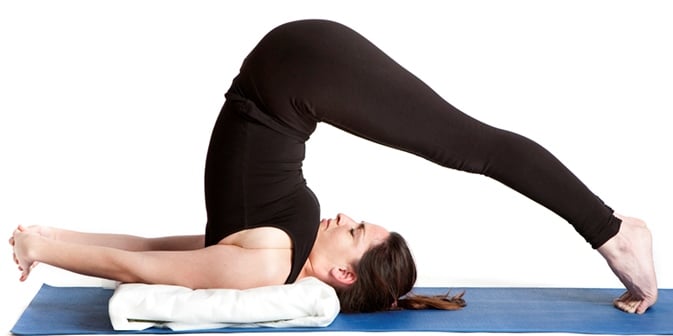
To get to Plow easily, start with Supported Shoulder Stand and allow your legs to drop down in a controlled manner until they are over your head. Let the arms fall straight out to your sides to help you balance. Some people like to interlace the fingers as they engage their arms against the floor. Remain in the pose for about 10 seconds, trying to breathe as deeply as possible. If there is too much pressure on your neck, come out of it by flipping your legs back up, or rolling to one side.

Revolved stomach pose, also known as Cat Stretch.
Lie on your back, arms outstretched. Bend your knees. Rotate the knees to your right so your legs are touching the mat and the shoulders and arms are still fully on the mat in the same place as when you started. Breathe deeply into your stomach and back and then return to your original position. Repeat on the left side.

Rock pose, also known as Hero pose.
Sit on your knees with your heels under your butt. Breathe into your stomach and back.
Seated Forward Bend
Use these poses and the ones in the Weight loss section if you need to in order to prevent diabetes, or get it under control.
Flat Abs
A good set of abs is one of the best ways to get rid of stubborn belly fat. Extra weight around the middle is not just unsightly, it is unhealthy as well. Doctors term it ‘waist roundness’ and it is commonly linked to diabetes, pre-diabetes and metabolic syndrome, which is related to pre-diabetes. If you are worried about your health, go for your gut and tighten those abs. This is a great flow sequence for strength and stability. The poses can be challenging, but worth the effort. If you struggle a lot even after a few attempts, skip the tough ones and focus on the poses you can do, and they try them again in a couple of months when you are fitter.

Boat
Start from a sitting position, your back straight. Raise your legs up as you stretch your arms out towards your knees, so your body is in a jackknife position.
Bridge
From Boat, go down to Corpse, rest a moment, tapping your abs lightly if they are sore, and the move into Bridge.
From Bridge, come to Rock. From Rock, you will move to Camel.

Camel
Start in Rock pose. Raise yourself off your heels so the front of your body is in line with your knees. Reach back to grip your ankles or the soles of your feet. Do the best you can. This is a pose that takes some time to master and to surrender to it.
Come back to Rock and down to Child if you want to stretch out. Then get back on your knees for Cat-Cow.
Cat-Cow
Go down to Chaturanga
And up to
Cobra.
Raise yourself to Mountain and do Chair.
Move back to Mountain.

Lotus-The classic yoga pose. Note the position of the feet compared with Easy pose. Both feet are resting on the tops of the opposite thighs.
Rock
Upward Dog
Warrior I and II
Keep up the good work and you should have rock-solid abs in no time.
Headache/Migraine
According to the World Health Organization’s most recent Fact Sheet on this topic:
- Headache disorders are among the most common disorders of the nervous system.
- It has been estimated that 47% of the adult population have had a headache at least once within the last year.
- Migraine is the 8th most disabling illness in the world.
- Headache disorders are associated with personal and societal burdens of pain, disability, damaged quality of life and financial cost.
- A minority of people with headache disorders worldwide are diagnosed appropriately by a health-care provider.
- Headache has been underestimated, under-recognized and under-treated throughout the world.
According to the National Headache Foundation:
- Nearly 1 in 4 U.S. households includes someone with migraine.
- More than 12% of the population – including children – suffers from migraine, which is more than diabetes and asthma combined.
- About 18% of American women and 6% of men suffer from migraine.
- Migraine is most common during the peak productive years, between the ages of 25 and 55.
- Every 10 seconds, someone in the United States goes to the emergency room with a headache or migraine.
- 14 million people or about 4% have chronic daily headache, defines as attacks that occur at least 15 days per month.
- More than 90% of sufferers are unable to work or function normally during their migraine.
The best way to deal with migraine is through prevention. These poses can help.
- Big Toe
- Bridge
- Corpse
- Dolphin
- Downward Dog
- Plow
- Seated Forward Bend
- Standing Forward Bend
- Standing Wide-Legged Forward Bend
As you can see, these are all poses you have already learned in relation to other health issues, so these can be termed Ôsuper poses’ that serve more than one purpose and should be part of most people’s overall workout. Having said that, in relation to migraine, there are a few poses best avoided.
AVOID
Boat
Cobra
Upward dog
Rock
Headstands
Shoulder Stands
Handstands
Your own yoga practice can be finely tuned to meet all your needs if you keep journaling and add or subtract poses you would like to do in relation to your individual health issues.
Heart Health
Heart issues are the #1 cause of death in both men and women in the US. Unfortunately, it is still viewed as a Ôman’s disease’ by many people. Yoga is great for improving circulation and even lowering cholesterol. Here are a few poses to try and several to avoid if you have heart problems.
Big Toe Pose
Bound Angle
Bridge
Cat-Cow
Chair
Cobra
Dolphin
Dolphin Plank
AVOID
Boat
Headstands
Handstands
Shoulder stands
Too many lunges
Use your journal to come up with a list of poses you can do safely no matter which medical conditions or health goals you need to deal with.
High Blood Pressure
High blood pressure is a leading cause of stroke, which in turn is a leading cause of death or serious disability. High blood pressure can usually be alleviated with a low sodium diet and exercise. Yoga will generally help to relieve high blood pressure, but some poses are better than others for this health condition. It is also important to note which ones to avoid if you have high blood pressure:
DO:
Bridge
Corpse
Downward Dog
Legs up the wall
Rock pose
Sitting Forward Bend
AVOID:
Camel
Headstand
Pigeon (all versions)
Plow
Shoulder Stands
Headstands
Handstands
Journal about all you have learned to make a list of all the safest poses you can use depending on which medical conditions you are dealing with.
Insomnia
Insomnia affect around 40 million people every night. Over time, sleep deprivation can have serious consequences for your health, weight and ability to perform your job. The American Academy of Sleep Medicine offers a useful fact sheet on what insomnia is and what can be done about it.
Insomnia is not just a case of not being able to fall asleep. It is also related to not being able to stay asleep or to experience quality sleep that refreshes body and mind. If you’ve been tossing and turning a lot lately, try these yoga poses. Just don’t do them an hour before bedtime, because all exercise is energizing.
Big toe
Bridge
Cat-Cow
Corpse
Dolphin
Seated Forward Bend, 1 leg drawn in
Bend your right leg inward so the sole of the foot is resting on the opposite thigh. Fold forward from the pelvis and try to touch the toes or lower part of your leg. Hold and breathe for 15 seconds.
Plow

Reclining Bound Angle
Sit in Butterfly or Cobbler pose. Ease yourself onto your back with the help of your elbows. Or, start in Corpse pose, bend your knees so the soles of the feet are touching, and breathe into the pose.
Supported Shoulder Stand
AVOID
Camel
Too much Downward dog
Too many lunges
Handstands
Headstands
Shoulder stands
Plow
Do the poses you like best, and remember to keep track in your journal of the safest poses that will also be the most effective in relation to all your health issues.
Osteoporosis
Osteopenia and osteoporosis are two health conditions related to our bones thinning as we age. Most people imagine their bones to be solid and unchanging. In fact, they are constantly breaking down and being built back up again. Women who undergo menopause and men who do not have a balanced diet rich in calcium and Vitamin D, the building blocks of strong healthy bone, can be more prone to fracture. This can in turn lead to serious disability and even death, such as from a broken hip and inactivity triggering pneumonia or blood clots in the legs.
Any weight bearing exercise can help combat osteopenia and osteoporosis. This includes lifting light weights, using resistance bands, and/or doing weight-bearing poses in yoga. Here are some of the most effective ones to keep your bones healthy no matter what your age.
Mountain
Tree
Chair
Triangle
Warrior II
Big Toe
Dolphin
Bridge
Locust
Cat stretch
Legs up the wall
Camel if you want to really challenge yourself
Stress and Anxiety
Everyone is stressed these days, but yoga poses and breath work can ease it and help you worry less and enjoy life more.
Big Toe
Boat
Bridge
Cat-Cow
Child
Cobra
Corpse with long deep breathing
Dolphin
Dolphin Plank
Easy pose with deep breathing
Happy Baby
Locust
Reclining Bound Angle
Seated Forward Bend
Standing Forward Bend
Yoga Nidra Meditation
Cooling Breath in Easy Pose at the end of your session
Strong Core
A solid set of core muscles can help keep your body strong and protect you from back pain. It gives you a stable base for all your daily activities, from working and shopping to walking your dog or chasing the kids or grandkids.
Boat
Bridge
Chaturanga Plank to

Side plank.
From plank, put your feet close together and pivot on them. Move carefully to avoid falling over. You can put your knee down if you need to and then try to push up.
Dolphin Plank
Dolphin Side Plank-rest on your forearm rather than your hand as you pivot to the side
Do side plank of both sides
Legs up the Wall
Upward Dog
All the Warrior poses, I, II, III and Reverse

Warrior III
From Warrior II, raise your back foot off the ground and lower your arms to your sides.
Do these poses every day and you will be amazed at how rock-hard your abs are and how great you look in your clothes.
Weight Loss
With more than 68% of Americans now overweight, obese, or morbidly obese, that is, so fat it could cause death, chances are you are hoping yoga will help you slim down. Weigh yourself and make note of the number in your journal. Set a weight loss goal and track your progress to success.
Boat
Chair
Chaturanga
Cobbler / Butterfly
Plank to
Side Plank
Seated Forward Bend
Standing Forward Bend
Tree
Upward Dog
Warrior I and II
Warrior-Reverse
Keep track in your journal of the best poses to do if you have any other underlying health issues, and aim for super poses that can be used for a number of health issue. You should soon be able to develop an individualized practice just right for all your needs and goals.
Free tool
Yoga Flow Builder — create a gentle, guided session with video for every pose.
Frequently asked questions
Is yoga good for older adults?
Yes. Gentle and chair yoga improve balance, flexibility and strength, which helps prevent falls. Start with a class designed for older adults or beginners.
Can yoga lower blood pressure?
Studies show modest reductions, particularly when yoga includes breathing and relaxation. Keep taking any prescribed medication and avoid strong inversions if your blood pressure is high.
Which yoga is best for back pain?
Gentle Hatha or therapeutic yoga, with poses such as Cat-Cow, Child’s pose and gentle twists. Avoid deep forward bends and twists if they increase pain, and see a professional for persistent pain.
How long until I feel the benefits?
Many people feel calmer after one session. Physical changes such as better flexibility and less pain usually take 6–8 weeks of regular practice.
Trusted resources
- Yoga: What You Need To Know (U.S. National Center for Complementary and Integrative Health)
- Exercise and Physical Fitness (MedlinePlus)
- Yoga for arthritis (Arthritis Foundation)
- Exercise and fitness (Harvard Health)
Related: yoga for beginners, types of yoga and Kundalini yoga.
This article is for general information and isn’t a substitute for advice from your doctor or another qualified health professional. Check with them before starting a new exercise or eating plan, especially if you have a health condition, are pregnant or take medication.