The 4-4 breath is about as simple as breathing practice gets. You breathe in through your nose for a count of four, then out for a count of four. Because the in-breath and out-breath are the same length, it is often called equal breathing.
The steady count gives a busy mind one small job to do. Many people find that alone helps them feel more settled. It is a gentle Sunday practice and a good one to learn before trying longer or faster techniques.
At a glance
- Good for: racing thoughts, short resets during the day, building a breathing habit
- Time: 2 to 5 minutes
- Position: sitting cross-legged as in the video, or upright on a chair
- Pattern: in for 4, out for 4, through the nose
How to Do the 4-4 Breath
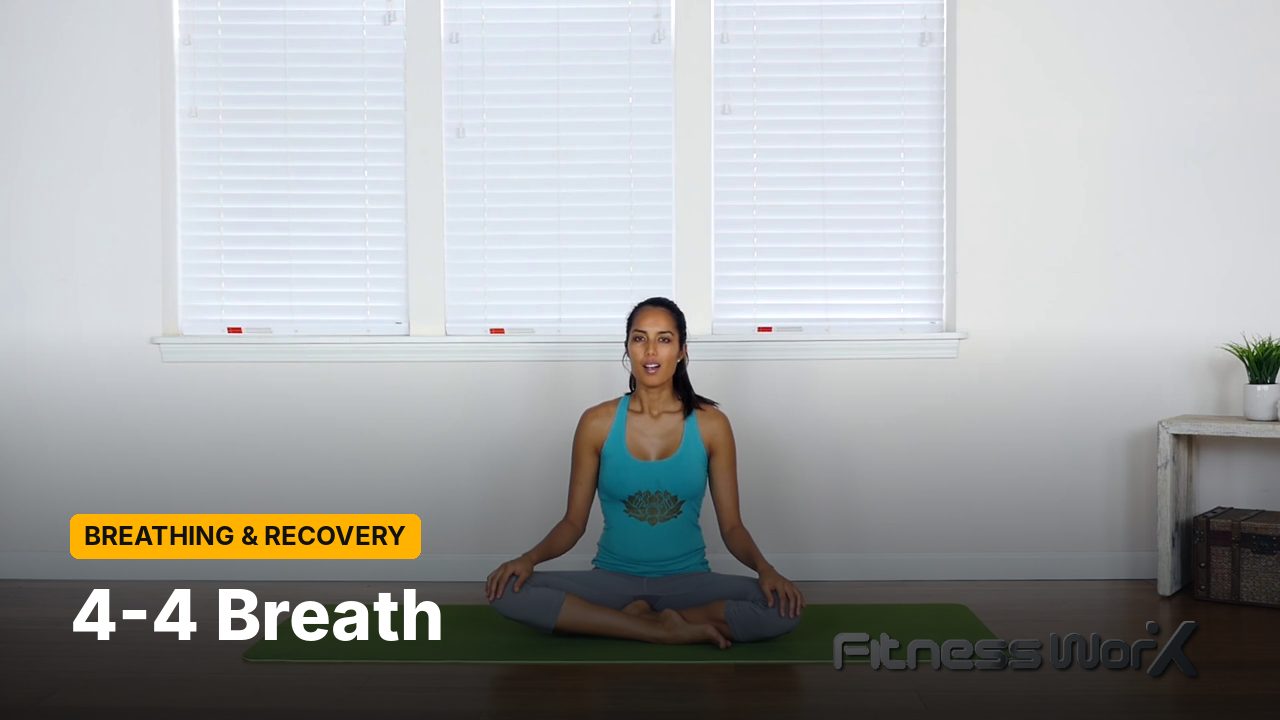
In the video the instructor sits in an easy cross-legged position on her mat. Her spine is tall, her shoulders are relaxed and her hands rest lightly on her knees. Her body stays still while her breath does the work.
- Sit tall. Cross your legs on a mat or cushion, or sit near the front of a chair with your feet flat. Let your hands rest on your knees or thighs.
- Relax your face and shoulders. Close your eyes or lower your gaze to the floor. Take two or three normal breaths.
- Breathe in for 4. Breathe in slowly through your nose while you count to four in your head. Let your belly and ribs widen.
- Breathe out for 4. Breathe out through your nose for the same count of four. Keep the out-breath smooth, not rushed.
- Keep the counts even. Move straight from the in-breath to the out-breath with no hold. Each count should feel about the same speed.
- Repeat. Continue for two to five minutes, then let your breathing return to normal before you open your eyes.
When to Use It
Equal breathing is easy to use almost anywhere. Try it at your desk before a meeting, in a parked car before you set off, or for a minute while the kettle boils. Nobody needs to know you are doing it.
It also makes a good bridge between two other techniques. Last Sunday we covered long slow deep breathing, which is slower and deeper. The 4-4 breath is a little quicker and easier to keep up while you go about your day. For a side-by-side look at five beginner techniques, see our guide to breathing exercises for beginners.
Tips for Beginners
- Change the count if you need to. If four feels too long, use three. If it feels too short, try five. The key is that in and out stay equal.
- Count slowly, not fast. A count of about one second each works well for most people.
- Do not force fullness. You are not trying to fill your lungs completely. A comfortable breath is enough.
- Use a timer. A gentle on-screen guide means you can stop watching the clock.
- Practise when calm. A few minutes on easy days makes the technique easier to use on stressful ones.
If you would like to add some movement afterwards, a few minutes of a 10-minute home yoga practice pairs well with this breath.
Stop if...
- You feel dizzy, light-headed or tingly. Breathe normally and rest. Next time, take smaller breaths.
- You feel you cannot get enough air. Shorten the count to three or return to normal breathing.
- Your nose is blocked. Breathe gently through your mouth or wait until it clears.
- You have asthma, COPD or a heart condition. Ask your doctor whether breathing exercises suit you.
- Sitting cross-legged hurts your knees or hips. Use a chair instead.
- You are driving. Keep your eyes open and your attention on the road, and save practice for when you have stopped.
Free tool
Breathing Exercise Timer
Choose Equal breathing in our free timer and follow the on-screen guide for 4 counts in and 4 counts out.
Yoga
Practice with a guided session
Pick your time and level and follow a yoga session with a video for every pose.
FAQ
What is the difference between 4-4 breathing and box breathing?
Box breathing adds a hold after the in-breath and after the out-breath. The 4-4 breath has no holds at all, so it is simpler and gentler for beginners.
How many minutes of equal breathing should I do?
Two to five minutes is a good start. You can do it once a day or several times in short bursts. Many people find short, regular sessions easier to keep up than one long one.
Should I breathe through my nose or mouth?
Breathe through your nose if you can. It helps keep the breath slow and smooth. If your nose is blocked, gentle mouth breathing is fine.
This page is for general information and relaxation, not medical or mental health care. If you feel lightheaded, dizzy or uncomfortable, stop and breathe normally. Check with your doctor first if you have a heart, lung or blood pressure condition, or are pregnant.