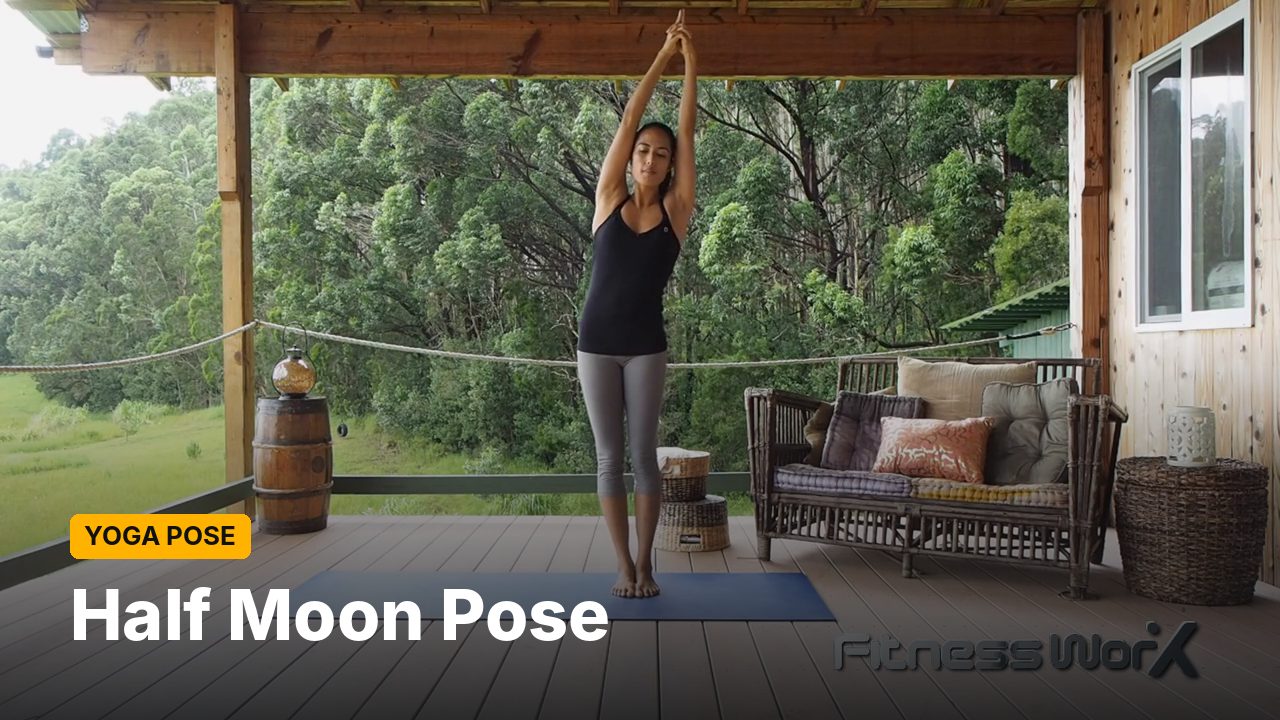
Half Moon Pose, as shown here, is a standing side bend. You stand tall with your feet together, press your palms together overhead and curve your whole body to one side, like the shape of a crescent moon. It stretches the sides of the waist, the ribs and the shoulders.
Some styles, including the classic hot yoga sequence, call this side bend Ardha Chandrasana. Many other styles use the same name for a harder one-legged balancing pose. This page covers only the standing side bend, which suits beginners and anyone who wants an easy stretch without getting down on the floor.
At a glance
- Type: standing side bend
- Level: beginner
- Hold: 3 to 5 slow breaths per side, 2 rounds
- Props: none; a wall behind you or a chair nearby for balance
How to Do the Half Moon Side Bend
In the video, the instructor stands with her feet together and raises her arms, palms touching. She bends to one side, comes back up through the centre, then bends to the other side. The movement is slow and controlled the whole time.
- Stand tall. Bring your feet together, or hip-width apart for more balance. Press evenly through both feet and soften your knees slightly.
- Raise your arms. Breathe in and sweep your arms up overhead. Press your palms together, or interlace your fingers and point the index fingers up.
- Grow taller. Reach up through your fingertips and lift your ribs away from your hips. This length comes before the bend.
- Bend to one side. Breathe out and curve slowly to the right. Press your left hip gently out to the left so the body makes a long arc.
- Keep your chest facing forward. Imagine you are between two panes of glass. Do not let your chest roll down towards the floor.
- Breathe and return. Stay for 3 to 5 breaths. Breathe in to come back to centre, then repeat on the left.
- Finish. Lower your arms slowly by your sides and take a breath before moving on.
Benefits of the Standing Side Bend
We spend most of the day moving forward and back, and rarely bend sideways. This pose stretches the muscles along the sides of the waist and between the ribs. Many people find it makes breathing feel freer afterwards.
Holding the arms overhead also asks the shoulders and upper back to work. Standing with feet together trains steady balance, which is a useful skill to keep as you get older.
Modifications
- Feet apart: Stand with your feet hip-width apart. This gives you a wider base if you feel wobbly.
- One arm up: Raise one arm and rest the other hand on your hip or thigh. Bend away from the raised arm. This is kinder to stiff shoulders.
- Use a wall: Stand with your back close to a wall. It keeps you from tipping forward or back.
- Seated version: Sit tall on a sturdy chair with feet flat and do the same side bend from the waist up.
- Smaller bend: Bend only a little. The stretch comes from lifting first, not from going far.
Skip or change this pose if
- you have a shoulder injury or cannot raise your arms comfortably. Use the one-arm or hands-on-hips version.
- you feel dizzy with your arms held overhead, or have uncontrolled high blood pressure. Keep the holds short and the arms lower.
- you have back pain that gets worse when you bend sideways. Make the bend very small, or skip it.
- your balance is unsteady. Stand with feet apart and keep a chair or wall within reach.
- you have had recent abdominal, chest or spine surgery.
- you are pregnant. Stand with feet wider and keep the bend gentle.
Stop if you feel sharp pain, pinching in the lower back or tingling in the arms.
Poses That Go Well With Half Moon
This side bend is a nice standing warm-up. Try it after a few slow breaths and before a lunge such as Low Lunge. Later in your practice, a lying backbend like Fish Pose opens the front of the chest in a different direction.
Want to find poses by body area or level? Try the Yoga Pose Finder. You can also plan a short sequence with the Yoga Flow Builder, or start with our yoga for beginners guide.
Yoga
Practice with a guided session
Pick your time and level and follow a yoga session with a video for every pose.
FAQ
Why are there two different Half Moon Poses?
Different yoga styles use the same name for different shapes. In some sequences, Half Moon is this standing side bend. In others, it is a balance on one leg with the body tipped sideways. Check the video to see which one a class means.
Should I feel Half Moon in my lower back?
You should feel a stretch along the side of your waist and ribs. A pinch in the lower back usually means you are bending too far or leaning backwards. Lift taller and make the bend smaller.
Can I do this side bend every day?
Yes, for most people. It is gentle and needs no equipment. A few slow rounds in the morning or during a work break are enough.
This page is for general information and isn’t a substitute for advice from your doctor, physiotherapist or another qualified health professional. Check with them before starting a new exercise program, especially if you have a health condition or injury, are pregnant or have recently given birth. Stop if you feel pain, dizziness or unusual shortness of breath.