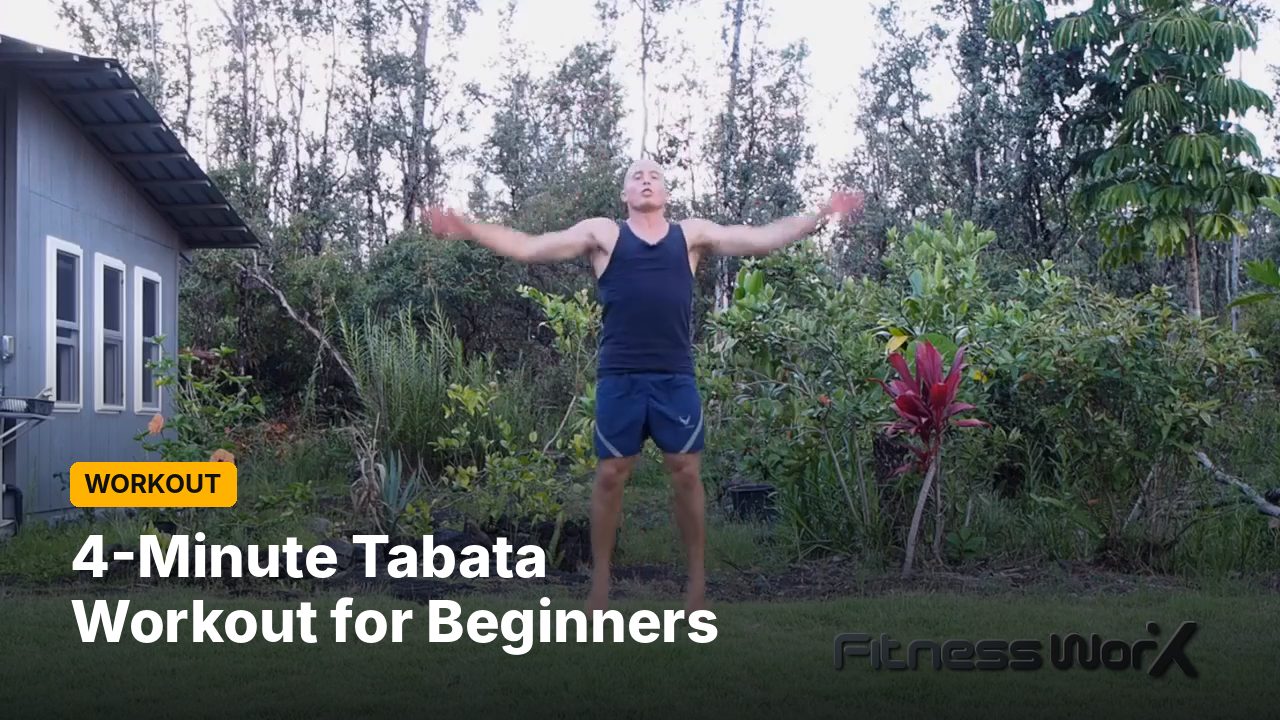
Tabata is a style of interval training with a very simple structure. You work hard for 20 seconds, rest for 10 seconds, and repeat that 8 times. The whole thing takes 4 minutes, which makes it one of the easiest workouts to fit into a busy day.
This beginner version uses four moves that need no equipment: jumping jacks, squats, mountain climbers and high knees. Each move appears twice. Every jumping move has a low-impact swap, so it also suits adults over 40 and anyone who prefers to keep one foot on the floor.
Workout at a glance
- Time: 4 minutes of Tabata, plus a 3-minute warm-up and 2-minute cool-down (about 9 minutes in total)
- Rounds: 8 rounds, 4 moves done twice
- Work and rest: 20 seconds of work, 10 seconds of rest
- Equipment: none
- Level: beginner, with low-impact options
Warm-Up
Do not skip this part. Ten seconds of rest is short, so your body needs to be ready before the first round. Spend about 3 minutes on the moves below.
- March on the spot for 1 minute, swinging your arms.
- Do 10 slow half squats.
- Step side to side for 30 seconds, reaching your arms overhead.
- Finish with 30 seconds of gentle marching with higher knees.
The Workout
Set a timer for 8 rounds of 20 seconds on and 10 seconds off. Use the 10-second rest to breathe and get into position for the next move. “Hard” means hard for you. On a scale of 1 to 10, aim for about a 6 or 7 in your first few weeks.
| Move | Time or reps | Rest |
|---|---|---|
| Round 1: Jumping jacks | 20 seconds | 10 seconds |
| Round 2: Bodyweight squat | 20 seconds | 10 seconds |
| Round 3: Mountain climbers | 20 seconds | 10 seconds |
| Round 4: High knees | 20 seconds | 10 seconds |
| Round 5: Jumping jacks | 20 seconds | 10 seconds |
| Round 6: Bodyweight squat | 20 seconds | 10 seconds |
| Round 7: Mountain climbers | 20 seconds | 10 seconds |
| Round 8: High knees | 20 seconds | 10 seconds (done) |
1. Jumping Jacks
Jump your feet out wide as your arms rise overhead, then jump back together. Land softly on the balls of your feet. For a low-impact version, step one foot out to the side at a time while your arms move overhead.
2. Bodyweight Squat
Sit your hips back and down, keeping your chest up and your knees in line with your toes. Stand up by pressing through your whole foot. Keep a steady rhythm rather than rushing. See our bodyweight squat guide for full form tips.
3. Mountain Climbers
Start in a high plank with your hands under your shoulders. Drive one knee toward your chest, then switch legs in a running motion. Keep your hips level. To make it gentler, put your hands on a sturdy chair or step each foot in slowly instead of running.
4. High Knees
Run on the spot, lifting your knees toward hip height and pumping your arms. Stay light on your feet and stand tall. The low-impact version is a fast march, lifting each knee as high as is comfortable.
Cool-Down
Walk slowly around the room for about 1 minute until your breathing settles. Then spend another minute on easy stretches for your thighs, calves and chest, holding each for about 15 to 20 seconds. If your heart is still racing, a few slow breaths can help. Our guide to breathing exercises for beginners has simple ones to try.
Make It Easier or Harder
Easier: use all the low-impact versions, or work for 15 seconds and rest for 15 seconds. You can also do 4 rounds instead of 8 for your first week. A slower pace is fine. Moving well matters more than moving fast.
Harder: rest for 1 minute after the 8 rounds and do a second Tabata block. You can also swap the squat for a jump squat once your knees and form are ready. If you want a longer session first, try our 10-minute bodyweight workout and finish with one Tabata block.
Want to swap in other moves? The Tabata Workout Builder creates new 4-minute plans from a list of exercises.
Safety Tips
Tabata is intense for its length, so start gently. Stop if you feel chest pain, dizziness, faintness or unusual shortness of breath. Use the low-impact versions if you have knee, hip or ankle problems, a pelvic floor concern, or are pregnant. If you have high blood pressure, a heart condition or have been inactive for a while, check with your doctor before doing high-intensity intervals. You can use the Heart Rate Zone Calculator to get a feel for your training zones.
Free tool
Interval Timer (HIIT & Tabata)
Set the Interval Timer to 20 seconds on, 10 seconds off and 8 rounds, and it will count every round for you.
FAQ
Can a 4-minute workout really make a difference?
It can help, especially if you do it a few times a week and keep the effort honest. Think of it as a useful start, not a full exercise plan. Adding walking or longer sessions on other days gives you more benefit.
How often should a beginner do Tabata?
Two or three times a week is plenty at first. Leave at least one easier day between sessions so your body can recover.
Is Tabata safe for people over 40?
Many people over 40 do Tabata safely, especially with low-impact moves and a good warm-up. Work at a level that feels hard but controlled, and talk to your doctor first if you have any heart, blood pressure or joint concerns.
This page is for general information and isn’t a substitute for advice from your doctor, physiotherapist or another qualified health professional. Check with them before starting a new exercise program, especially if you have a health condition or injury, are pregnant or have recently given birth. Stop if you feel pain, dizziness or unusual shortness of breath.